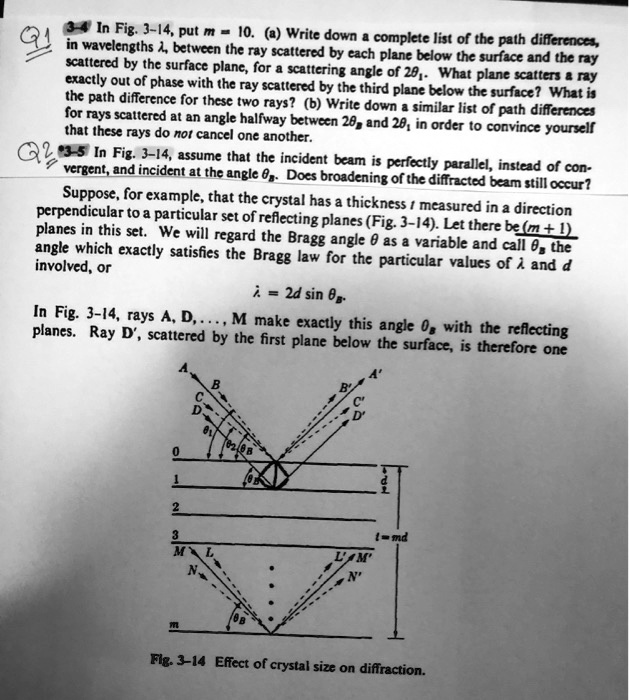
34 In Fig.3-14, put m = 10. Write down a complete list of the path differences in wavelengths, λ, between the ray scattered by each plane below the surface and the ray scattered by the surface plane, for a scattering angle of 29°. What plane scatters a ray exactly out of phase with the ray scattered by the third plane below the surface? What is the path difference for these two rays?
In part b, write down a similar list of path differences for rays scattered at an angle halfway between 20° and 28° in order to convince yourself that these rays do not cancel each other out.
35 In Fig.3-14, assume that the incident beam is perfectly parallel, instead of convergent, and incident at the angle θ. Does broadening of the diffracted beam still occur? Suppose, for example, that the crystal has a thickness t measured in a direction perpendicular to a particular set of reflecting planes (Fig.3-14). Let there be (m+1) planes in this set. We will regard the Bragg angle, θ, as a variable and call it θ_B, the angle which exactly satisfies the Bragg law for the particular values of θ and d = 2dsinθ_B. In Fig.3-14, rays A, D, ..., M make exactly this angle θ_B with the reflecting planes. Ray D scattered by the first plane below the surface is therefore one of the rays.