Ace - AI Tutor
Ask Our Educators
Textbooks
My Library
Flashcards
Scribe - AI Notes
Notes & Exams
Download App
alexis black

alexis b.

Divider

Questions asked

BEST MATCH

How would I respond to this? I would use results from the PARQ to help with relational interventions. If I know a client struggles with parental rejection, I might look for moments where they repeat similar dynamics in therapy or current relationships. It would also help me notice when I have a countertransference reaction that may be related to how I am positioned in their system. From a family systems perspective, this tool gives insight into how the family environment shaped the client’s early sense of safety and how those patterns might be reenacted now.

View Answer
divider
BEST MATCH

Presynaptic and somatodendritic opioid autoreceptors Group of answer choices Hyperpolarize presynaptic cell Activate Gproteins Alter cation (+ ion) conductance Reduce post-synaptic cell firing All of the above

View Answer
divider
BEST MATCH

Suppose that $x$ and $y$ are differentiable functions of $t$ and that $144 = x^2 + y^2$, then $\frac{dy}{dt} = \boxed{\phantom{000}}$ Use either $\frac{dx}{dt}$ or $x'(t)$ in your answer. If $\frac{dx}{dt} = -7$ when $x = 5$ and $y > 0$, then $\frac{dy}{dt}|_{x=5} = \boxed{\phantom{000}}$

View Answer
divider
BEST MATCH

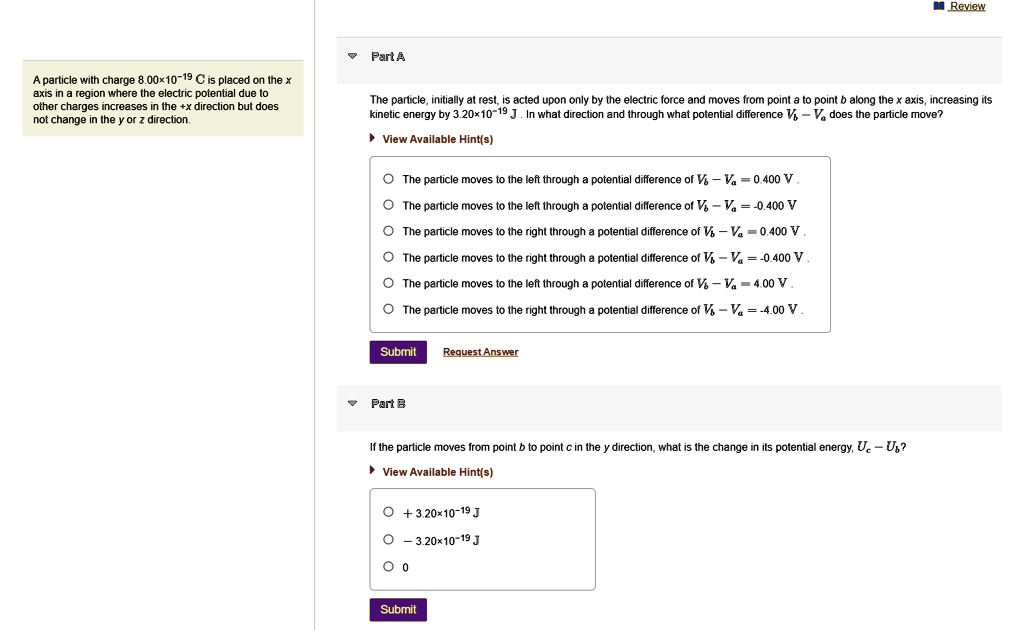
A particle with charge $8.00 \times 10^{-19}$ C is placed on the x axis in a region where the electric potential due to other charges increases in the +x direction but does not change in the y or z direction. Part A The particle, initially at rest, is acted upon only by the electric force and moves from point a to point b along the x axis, increasing its kinetic energy by $3.20 \times 10^{-19}$ J. In what direction and through what potential difference $V_b - V_a$ does the particle move? The particle moves to the left through a potential difference of $V_b - V_a = 0.400$ V. The particle moves to the left through a potential difference of $V_b - V_a = -0.400$ V The particle moves to the right through a potential difference of $V_b - V_a = 0.400$ V. The particle moves to the right through a potential difference of $V_b - V_a = -0.400$ V. The particle moves to the left through a potential difference of $V_b - V_a = 4.00$ V. The particle moves to the right through a potential difference of $V_b - V_a = -4.00$ V. Part B If the particle moves from point b to point c in the y direction, what is the change in its potential energy, $U_c - U_b$? +3.20×10⁻¹⁹ J -3.20×10⁻¹⁹ J 0
View Answer
divider
BEST MATCH

(1 point) Compute \sum_(k=1)^2 (6k)/(k+1) Answer: (1 point) Compute $\sum_{k=1}^{2} \frac{6k}{k+1}$ Answer:

View Answer
divider
BEST MATCH

The primer in DNA replication is: ? a RNA starter sequence with a free 3' OH group ? a RNA starter sequence with a free 5' OH group ? a DNA starter sequence with a free 3' OH group ? a DNA starter sequence with a free 5' OH group

View Answer
divider
BEST MATCH

A key factor that explains the higher crime rates of urban areas is their greater population density. Which of the following could be targets for potential criminals in urban areas? Bars Convenience stores Other businesses All the above

View Answer
divider
BEST MATCH

\[ g(x)=\frac{25-x^{2}}{x^{2}+5 x} \] (a) Find the domain of \( g(x) \). \( x \neq-5, x \neq 5 \) \( x \neq 25 \) \( x \neq 25, x \neq 0 \) \( x \neq-5, x \neq 0 \) \( x \neq-5 \) \( x \neq 0 \) (b) How many solutions does each equation have? \[ \begin{array}{l} g(x)=0 \\ g(x)=1 \\ g(x)=-1 \end{array} \] \( \square \) \( \square \) \( \square \)

View Answer
divider
BEST MATCH

an oncogenic mutation was analogous to A broken brake A broken road A traffic accident An endless tank of gas A stuck accelerator

View Answer
divider
BEST MATCH

In economics, is a proportional or progressive tax better to maximize revenue?

View Answer
divider