Questions asked
How do you document a weak, thready, diminished pulse? +3 +1 +4 +2
The pKa of an amine group (-NH3+) is 8.0. Which statement is correct?
What is the psychoactive component in cannabis? tetrahydrocannabinol cannabinoid cannabidiol anxiolytician
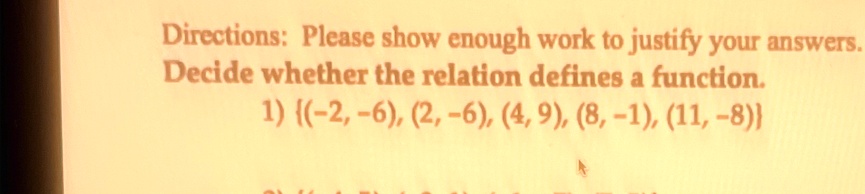
Directions: Please show enough work to justify your answers. Decide whether the relation defines a function. 1) {(-2, -6), (2, -6), (4, 9), (8, -1), (11, -8)}
When examining the evolution of warfare in the context of international relations, what best characterizes this progression? Warfare has steadily decreased in frequency and intensity, leading to global peace. Warfare has consistently become more lethal and destructive over time. Warfare has evolved to encompass a broader spectrum of tactics, including cyber, economic, and asymmetric methods. Warfare remains static and unchanging, driven primarily by traditional military strategies.
Question 6 The following Lewis structure for \( \mathrm{NO}_{2}^{-} \)is incorrect. Select the reason(s) why. This species should be neutral. There are too many electrons in the structure. There are too few electrons in the structure. Oxygen does not have a full octet. Nitrogen does not have a full octet. Oxygen cannot form double bonds.
Based on the monopoly cost curves above, answer the following question: What is the profit maximizing price at Comerica Park? $0 $10 $40 $30
In the laboratory, the technician determines Maggie's blood type. Maggie's blood agglutinates in anti-A antibodies, but has no reaction in anti-B or anti-D antibodies. What is Maggie's blood type? View Available Hint(s) for Part F B- A- A+ B+
Texts: Person-time years at risk for 8 participants in a 7-year cohort study (3 points) Subject Y (year 1) Y2 Y3 Y4 Y5 Y6 Y7 Years at risk 3 7 1.5 4.5 4 5.5 4 7 1 2 3 4 5 6 7 8 Time at risk Lost to follow-up Disease L X 3.1 Calculate the total number of years at risk for participants in this study (person-years). (1 point) 3.2 What were the total number of years at risk in this study at the end of year 3? (1 point) 3.3 Given that the incidence rate is the number of new cases of disease in a given time period divided by the total person-time at risk during the study period, what would the incidence rate of disease be for the above 7-year study? 3.3a Per person-year: (0.5 point) 3.3b Per 100 person-years (Round part b to the nearest decimal point): (0.5 point)
Convert the following base 10 numeral to a base 2 numeral and enter your answer in the box. 1059 Base 2 numeral: