Ace - AI Tutor
Ask Our Educators
Textbooks
My Library
Flashcards
Scribe - AI Notes
Notes & Exams
Download App
alexis rivas

alexis r.

Divider

Questions asked

BEST MATCH

Middle adulthood involves several physical changes that may contribute to thoughts on body image and attractiveness. Which of the following is not one of those physical changes? physical strength declines vision abilities decline lung capacity decreases height and weight changes

View Answer
divider
BEST MATCH

Capital ____ is the decision-making process for accepting and rejecting projects. O structure O spending O budgeting O relevance

View Answer
divider
BEST MATCH

Which of the following is a behavioral intervention undertaken for the treatment of insomnia? Multiple Choice aversion therapy hormone therapy systematic desensitization relaxation therapy

View Answer
divider
BEST MATCH

Math 106L Applications: Heating and Mixing I Lecture 13-2 Newton's Law of Cooling Newton formulated the principle that the rate of change of the temperature of an object is proportional to the difference between the object's temperature and the temperature of the surroundings. 1. (a) Suppose that the temperature of an object at time \( t \) is given by \( T(t) \). Denote the surrounding temperature \( T^{*} \), and assume it is constant. Write down a differential equation expressing Newton's Law of Cooling: \[ \frac{d T}{d t}=\underline{K\left(T-T^{*}\right)} \] Note that if the surrounding temperature is greater than the temperature of the object, we expect the temperature of the object to heat, whereas if the surrounding temperature is lower than the temperature of the object, we expect the temperature of the object to \( \mathrm{COO} \). Given that we usually take our constants of proportionality to be positive, does your equation above reflect this? If not, correct it. (b) What is the equilibrium solution to your differential equation? By sketching a slopefield (pick values of \( k \) and \( T^{*} \) if needed), determine if the equilibrium is stable or unstable. (c) Plot two solutions of the equation on your slopefield. One with \( T(0)>T^{*} \), and one with \( T(0)<T^{*} \). What is the behavior of the solutions as \( t \rightarrow \infty \) ? Why does this make sense?

View Answer
divider
BEST MATCH

In a perfectly competitive industry, in the long-run equilibrium Question 23 options: the typical firm earns zero profit. the typical firm is producing at the output where its long-run average total cost is not minimized. the typical firm is earning an accounting profit greater than its implicit costs. the typical firm is maximizing its revenue.

View Answer
divider
BEST MATCH

At what O2 pressure (in mm Hg) is hemoglobin 50% saturated with oxygen? ? 14 ? 21 ? 28 ? 39 ? 58 ? 80

View Answer
divider
BEST MATCH

5. Of the following measurements, which is most precise? O 120 grams O 1200 grams O 0.640 grams O 0.05660 grams O 1800.0 grams Question 6

View Answer
divider
BEST MATCH

tion of Energy Problems 1 of 4 Automatic Zoom Projectiles A 70kg diver drops off a 12m tower, with no initial velocity. a

View Answer
divider
BEST MATCH

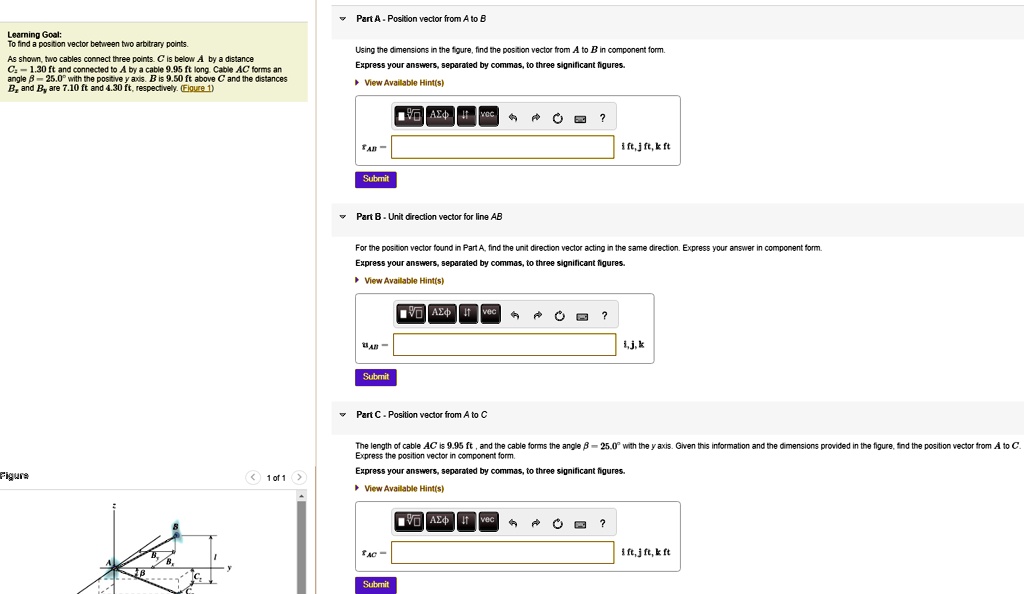
Learning Goal: To find a position vector between two arbitrary points. As shown, two cables connect three points. C is below A by a distance C_z = 1.30 ft and connected to A by a cable 9.95 ft long. Cable AC forms an angle \(\beta = 25.0^\circ\) with the positive y axis. B is 9.50 ft above C and the distances \(B_x\) and \(B_y\) are 7.10 ft and 4.30 ft, respectively. (Figure 1) Part A - Position vector from A to B Using the dimensions in the figure, find the position vector from A to B in component form. Express your answers, separated by commas, to three significant figures. Part B - Unit direction vector for line AB For the position vector found in Part A, find the unit direction vector acting in the same direction. Express your answer in component form. Express your answers, separated by commas, to three significant figures. Part C - Position vector from A to C The length of cable AC is 9.95 ft, and the cable forms the angle \(\beta = 25.0^\circ\) with the y axis. Given this information and the dimensions provided in the figure, find the position vector from A to C. Express the position vector in component form. Express your answers, separated by commas, to three significant figures.
View Answer
divider
BEST MATCH

:- A profile of a road (with V.S. = 1/25 and H.S. = 1/750) is used to measure Area of Cut and Fill and their lengths and found: AF = 264 cm$^2$ (from sta. 13+00 to sta. 16+40) and AC = 472 cm$^2$ (from sta. 16+40 to sta. 20+50). Compute total volumes of Cut and Fill by using Approximate Method, Knowing that: bF = 11m, 1/SF = 2:5, bC = 13 m, 1/SC = 2:7.

View Answer
divider