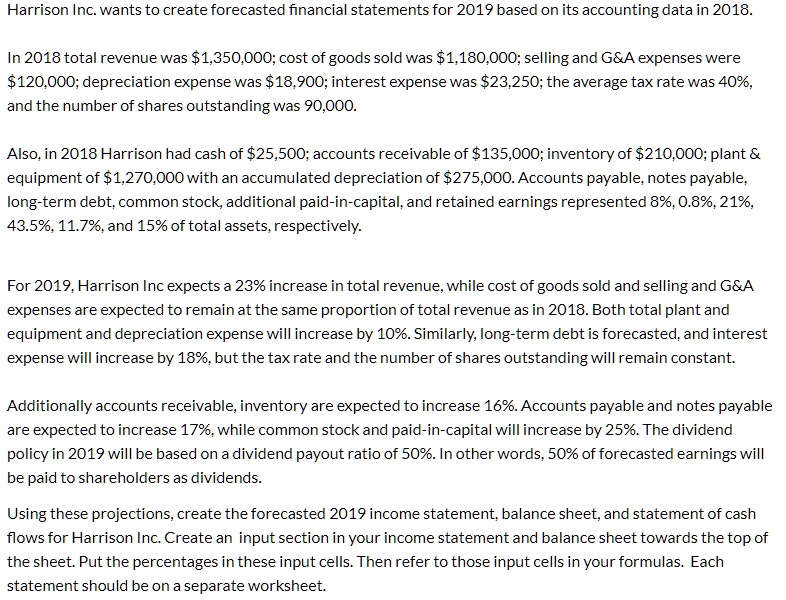
Harrison Inc. wants to create forecasted financial statements for 2019 based on its accounting data in 2018.
In 2018, total revenue was $1,350,000; cost of goods sold was $1,180,000; selling and G&A expenses were $120,000; depreciation expense was $18,900; interest expense was $23,250; the average tax rate was 40%, and the number of shares outstanding was 90,000.
Also, in 2018, Harrison had cash of $25,500; accounts receivable of $135,000; inventory of $210,000; plant & equipment of $1,270,000 with an accumulated depreciation of $275,000. Accounts payable, notes payable, long-term debt, common stock additional paid-in-capital, and retained earnings represented 8%, 0.8%, 21%, 43.5%, 11.7%, and 15% of total assets, respectively.
For 2019, Harrison Inc. expects a 23% increase in total revenue, while cost of goods sold and selling and G&A expenses are expected to remain at the same proportion of total revenue as in 2018. Both total plant and equipment and depreciation expense will increase by 10%. Similarly, long-term debt is forecasted, and interest expense will increase by 18%, but the tax rate and the number of shares outstanding will remain constant.
Additionally, accounts receivable and inventory are expected to increase by 16%. Accounts payable and notes payable are expected to increase by 17%, while common stock and paid-in-capital will increase by 25%. The dividend policy in 2019 will be based on a dividend payout ratio of 50%. In other words, 50% of forecasted earnings will be paid to shareholders as dividends.
Using these projections, create the forecasted 2019 income statement, balance sheet, and statement of cash flows for Harrison Inc. Create an input section in your income statement and balance sheet towards the top of the sheet. Put the percentages in these input cells. Then refer to those input cells in your formulas. Each statement should be on a separate worksheet.