Answer 6.2 only!
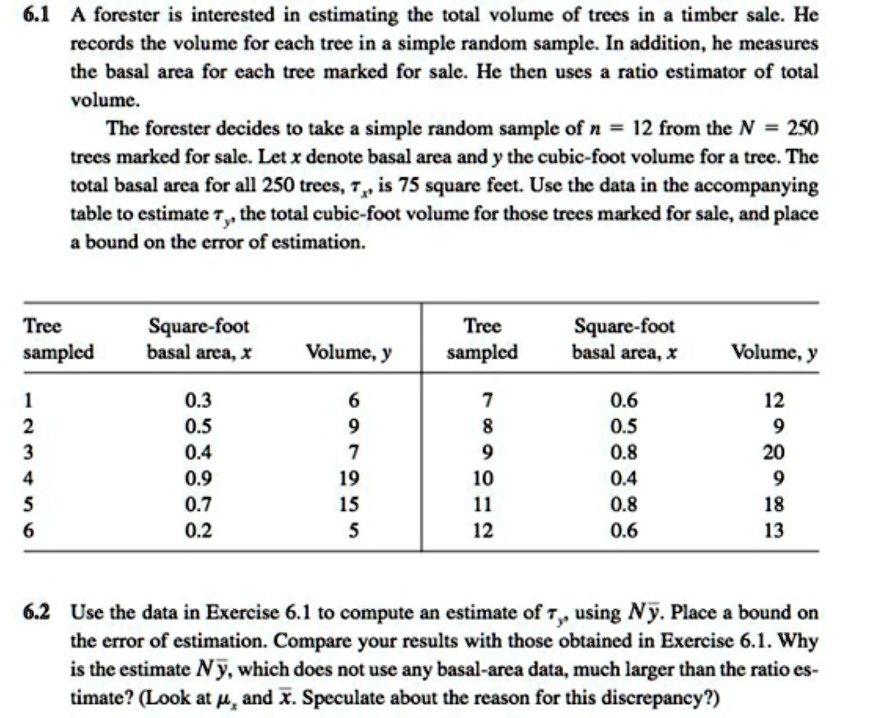
6.1 A forester is interested in estimating the total volume of trees in a timber sale. He records the volume for cach tree in a simple random sample.In addition,he measures the basal area for each trec marked for sale. He then uses a ratio estimator of total volume. The forester decides to take a simple random sample of n = 12 from the N= 250 trees marked for sale.Let x denote basal area and y the cubic-foot volume for a tree.The total basal area for all 250 trees,Ty, is 75 square feet.Use the data in the accompanying table to estimate T,the total cubic-foot volume for those trees marked for sale,and place a bound on the error of cstimation.
Tree sampled
Square-foot basal area,x
Tree sampled
Square-foot basal area, x
Volume, y
Volume, y
1 2 3 4 5 6
0.3 0.5 0.4 0.9 0.7 0.2
6 9 7 19 15 5
7 8 9 10 11 12
0.6 0.5 0.8 0.4 0.8 0.6
12 9 20 9 18 13
6.2 Use the data in Exercise 6.1 to compute an estimate of T,using Ny.Place a bound on the error of estimation.Compare your results with those obtained in Exercise 6.1.Why is the estimate Ny,which does not use any basal-area data,much larger than the ratio es- timate? (Look at , and x. Speculate about the reason for this discrepancy?)