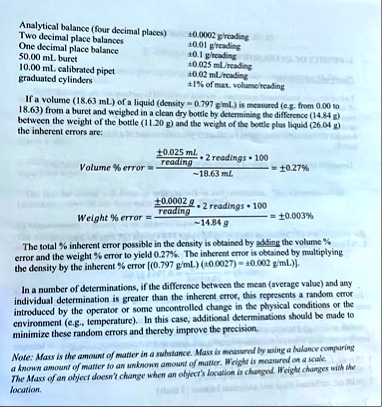
Analytical balance (four decimal places) $\pm 0.0002$ g/reading
Two decimal place balances $\pm 0.01$ g/reading
One decimal place balance $\pm 0.1$ g/reading
50.00 mL buret $\pm 0.025$ mL/reading
10.00 mL calibrated pipet $\pm 0.02$ mL/reading
graduated cylinders $\pm 1\%$ of max. volume/reading
If a volume (18.63 mL) of a liquid (density = 0.797 g/mL) is measured (e.g. from 0.00 to 18.63) from a buret and weighed in a clean dry bottle by determining the difference (14.84 g) between the weight of the bottle (11.20 g) and the weight of the bottle plus liquid (26.04 g) the inherent errors are:
Volume % error = $\frac{\pm 0.025 \text{ mL}}{\text{reading}} \cdot \frac{2 \text{ readings} \cdot 100}{18.63 \text{ mL}} = \pm 0.27\%$
Weight % error = $\frac{\pm 0.0002 \text{ g}}{\text{reading}} \cdot \frac{2 \text{ readings} \cdot 100}{\sim 14.84 \text{ g}} = \pm 0.003\%$
The total % inherent error possible in the density is obtained by adding the volume % error and the weight % error to yield 0.27%. The inherent error is obtained by multiplying the density by the inherent % error [(0.797 g/mL) ($\pm 0.0027$) = $\pm 0.002$ g/mL)].
In a number of determinations, if the difference between the mean (average value) and any individual determination is greater than the inherent error, this represents a random error introduced by the operator or some uncontrolled change in the physical conditions or the environment (e.g., temperature). In this case, additional determinations should be made to minimize these random errors and thereby improve the precision.
Note: Mass is the amount of matter in a substance. Mass is measured by using a balance comparing a known amount of matter to an unknown amount of matter. Weight is measured on a scale. The Mass of an object doesn't change when an object's location is changed. Weight changes with the location.