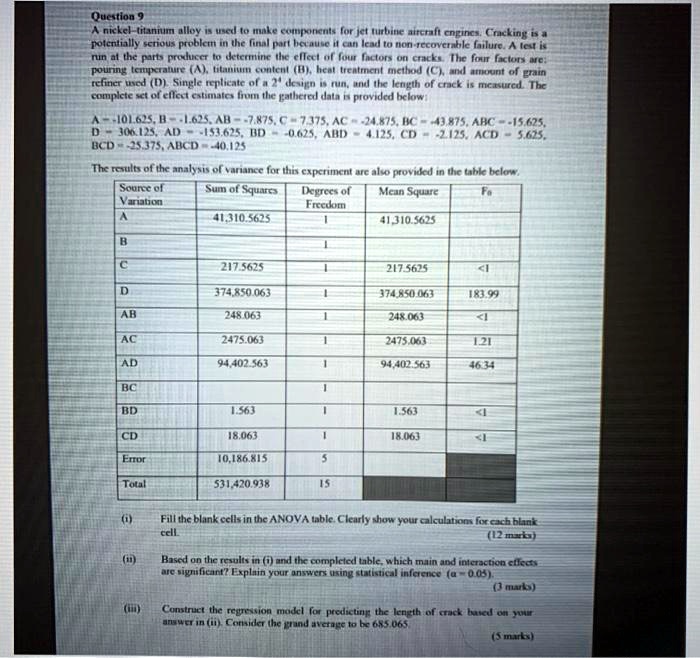
Potentially serious problem in the final part because it can lead to nonrecoverable failure. A test is run at the parts producer to determine the effect of four factors on crack. The four factors are refiner used. A single replicate of a 2 design is run, and the length of crack is measured. The complete set of effect estimates from the gathered data is provided below: A = -101.625, B = 1.625, X = -7.875, C = 7.375, AC = -24.875, BC = 43.875, ABC = -15.625, D = 306.125, AD = 153.625, BD = 0.625, ABD = 4.125, CD = -2125, ACD = -5.625, BCD = -25.375, ABCD = -40.125.
The results of the analysis of variance for this experiment are also provided in the table below:
Source of Variation | Sum of Squares | Degrees of Freedom | Mean Square
--- | --- | --- | ---
A | 41,310.5625 | 1 | 41,310.5625
B | 217.5625 | 1 | 217.5625
C | 217.5675 | 1 | 217.5675
D | 374,850.063 | 1 | 374,850.063
AB | 248.063 | 1 | 248.063
AC | 2475.063 | 1 | 2475.063
AD | 94,402.563 | 1 | 94,402.563
BC | 18.063 | 1 | 18.063
BD | 11 | 1 | 11
CD | 118,981.015 | 5 | 23,796.203
Error | 531,420.938 | 15 | 35,428.062
(ii)
Based on the results in i and the completed table, which main and interaction effects are significant? Explain your answers using statistical inference α = 0.05.
(iii)
Construct the regression model for predicting the length of crack based on your answer in i. Consider the grand average to be 685.065.