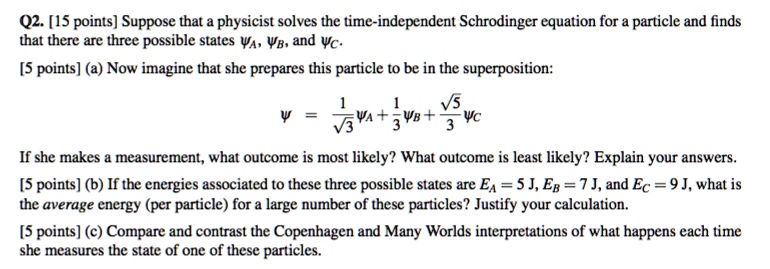
Q2. [15 points] Suppose that a physicist solves the time-independent Schrodinger equation for a particle and finds that there are three possible states $\Psi_A$, $\Psi_B$, and $\Psi_C$.
[5 points] (a) Now imagine that she prepares this particle to be in the superposition:
$\Psi = \frac{1}{\sqrt{3}}\Psi_A + \frac{1}{3}\Psi_B + \frac{\sqrt{5}}{3}\Psi_C$
If she makes a measurement, what outcome is most likely? What outcome is least likely? Explain your answers.
[5 points] (b) If the energies associated to these three possible states are $E_A = 5$ J, $E_B = 7$ J, and $E_C = 9$ J, what is the average energy (per particle) for a large number of these particles? Justify your calculation.
[5 points] (c) Compare and contrast the Copenhagen and Many Worlds interpretations of what happens each time she measures the state of one of these particles.