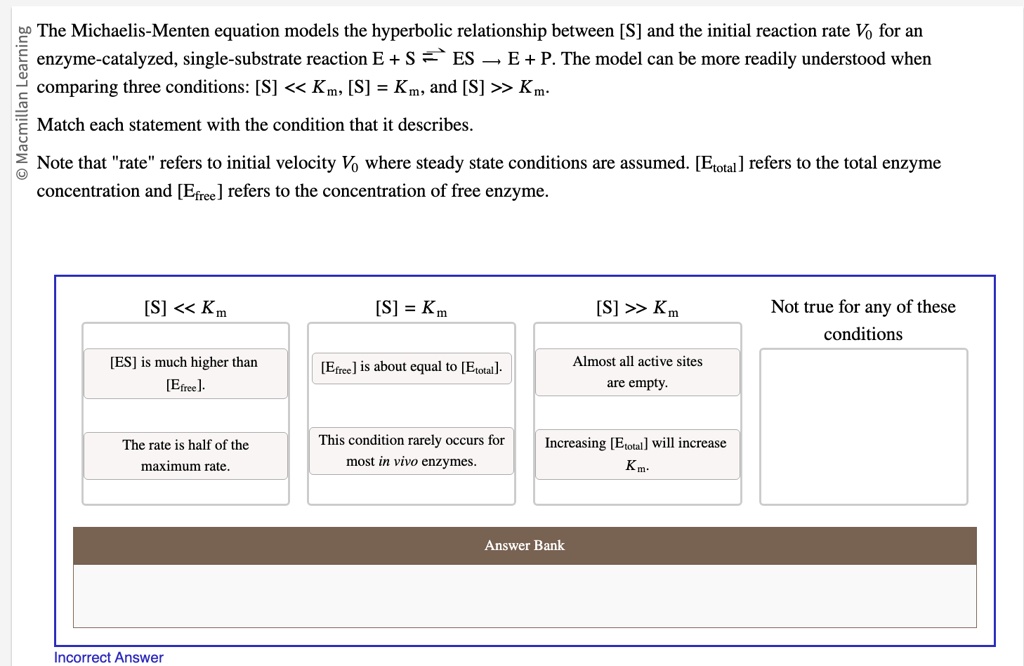
The Michaelis-Menten equation models the hyperbolic relationship between [S] and the initial reaction rate $V_0$ for an enzyme-catalyzed, single-substrate reaction $E + S \rightleftharpoons ES \longrightarrow E + P$. The model can be more readily understood when comparing three conditions: $[S] << K_m$, $[S] = K_m$, and $[S] >> K_m$.
Match each statement with the condition that it describes.
Note that "rate" refers to initial velocity $V_0$ where steady state conditions are assumed. $[E_{total}]$ refers to the total enzyme concentration and $[E_{free}]$ refers to the concentration of free enzyme.
[S] << $K_m$
[S] = $K_m$
[S] >> $K_m$
Not true for any of these conditions
[ES] is much higher than [$E_{free}$].
[$E_{free}$] is about equal to [$E_{total}$].
Almost all active sites are empty.
The rate is half of the maximum rate.
This condition rarely occurs for most *in vivo* enzymes.
Increasing [$E_{total}$] will increase $K_m$.