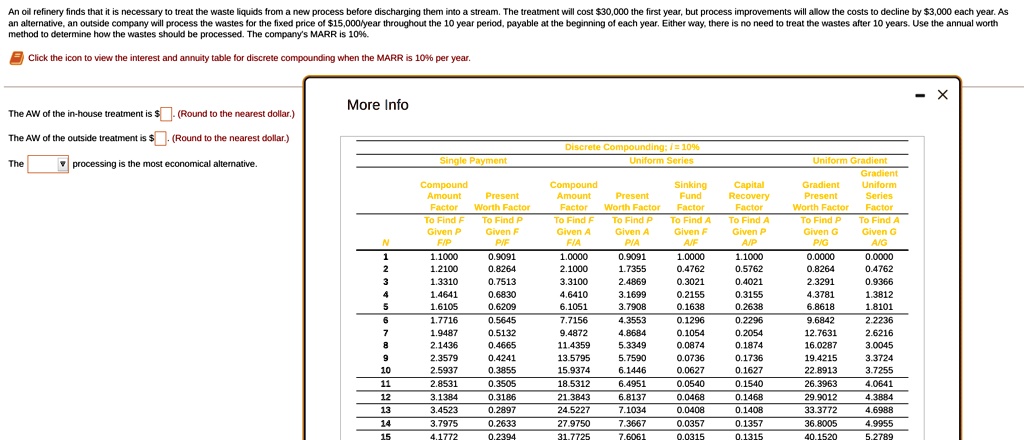
An oil refinery finds that it is necessary to treat the waste liquids from a new process before discharging them into a stream. The treatment will cost $30,000 the first year, but process improvements will allow the costs to decline by $3,000 each year. As
an alternative, an outside company will process the wastes for the fixed price of $15,000/year throughout the 10 year period, payable at the beginning of each year. Either way, there is no need to treat the wastes after 10 years. Use the annual worth
method to determine how the wastes should be processed. The company's MARR is 10%.
Click the icon to view the interest and annuity table for discrete compounding when the MARR is 10% per year.
The AW of the in-house treatment is $_____. (Round to the nearest dollar.)
The AW of the outside treatment is $_____. (Round to the nearest dollar.)
The ____ processing is the most economical alternative.