Ace - AI Tutor
Ask Our Educators
Textbooks
My Library
Flashcards
Scribe - AI Notes
Notes & Exams
Download App
alison cisneros

alison c.

Divider

Questions asked

BEST MATCH

Which of the following choices represents an oxidation-reduction reaction? Li$_2$CO$_3$(s) $\rightarrow$ Li$_2$O(s) + CO$_2$(g) Fe$_2$O$_3$(s) + 6HCl(aq) + 9 H$_2$O(l) $\rightarrow$ 2FeCl$_3$(H$_2$O)$_6$(aq) CaCO$_3$(s) + 2HCl(aq) $\rightarrow$ CaCl$_2$(aq) + H$_2$O(l) + CO$_2$(g) 3 HNO$_2$(aq) $\rightarrow$ HNO$_3$(aq) + 2NO(g) + H$_2$O(l)

View Answer
divider
BEST MATCH

Which of the following is true about the Bohr effect? It is a result of decreased temperature, pH, and PCO$_2$. It is a result of increased temperature, pH, and PCO$_2$. It results in an increased affinity of oxygen for hemoglobin at a given PO$_2$. It results in a decreased affinity of oxygen for hemoglobin at a given PO$_2$.

View Answer
divider
BEST MATCH

The graph above can be written as $y = f(t)u_a(t) + g(t)u_b(t)$\newline Where $f(t) =$\newline $a =$\newline $g(t) =$\newline $b = $

View Answer
divider
BEST MATCH

Find the following limit or state that it does not exist.\\ \( \lim_{h \to 0} \frac{\frac{5}{4+h} - \frac{5}{4}}{h} \)

View Answer
divider
BEST MATCH

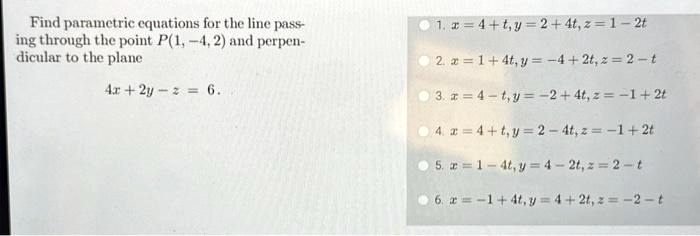
Find parametric equations for the line passing through the point P(1, -4, 2) and perpendicular to the plane $4x + 2y - z = 6$. 1. $x = 4 + t$, $y = 2 + 4t$, $z = 1 - 2t$ 2. $x = 1 + 4t$, $y = -4 + 2t$, $z = 2 - t$ 3. $x = 4 - t$, $y = -2 + 4t$, $z = -1 + 2t$ 4. $x = 4 + t$, $y = 2 - 4t$, $z = -1 + 2t$ 5. $x = 1 - 4t$, $y = 4 - 2t$, $z = 2 - t$ 6. $x = -1 + 4t$, $y = 4 + 2t$, $z = -2 - t$
View Answer
divider
BEST MATCH

Modify the pseudocode and Flowgorithm designs and the Python code from Lab 4.1A to use a For loop instead of a While loop. Upload the pseudocode and Flowgorithm designs (.frpg) and the Python code file.

View Answer
divider
BEST MATCH

Helium atoms have two electrons in their orbits. Assume that the electrons occupy the orbital states $u_{1s}$ and $u_{nl}$. Let the spatial state of the electrons be; $\psi_{space} = \frac{1}{\sqrt{2}}(u_{1s}(1)u_{nl}(2) + u_{nl}(1)u_{1s}(2))$ (4) The total wave function of the electrons is: $\Psi = \psi_{space}\psi_{spin}$ (5) Where $\psi_{spin}$ is the wave function of the electron spins. Write down the spin state and the spin angular momentum of this state.

View Answer
divider
BEST MATCH

You are an art dealer bidding in a sealed bid auction for a gold statue. You have a client who you believe would be prepared to pay $100,000 for the statue. It is a large statue and the amount of gold alone would be worth $60,000. You know that there are nine other art dealers bidding for the statue. What is your bidding strategy if it is a first price auction, and what would your bidding strategy be in a second price auction? Make sure you fully explain all the assumptions of your analysis and indicate their significance.

View Answer
divider
BEST MATCH

Find $R_{ab}$ (in Ohms) irf R=71. (Use 2 decimal places. Unit is not required) 91 a o b o 10 ? R 60 ? 20 ? 30 ?

View Answer
divider
BEST MATCH

The buttered toast phenomenon is the tendency of buttered toast, when it falls, to land buttered-side down in the majority of instances." (Wikipedia) Scientific studies have shown that the effect has little to do with the added weight or the aerodynamics of butter, but rather the table height. Consider the following simplified model: You have a 12.0 cm x 12.0 cm piece of toast of uniform density and of mass m (we will treat the toast as having no thickness to greatly reduce the complexity in the geometry). You knock the toast such that it is hanging 9.0 cm beyond the edge (see below, left) of a 75 cm high table, so it is about to tip and fall. We will assume that the toast is initially at rest, not sliding horizontally. The toast rotates without slipping around the table corner until it reaches 7 with the horizontal (see below, middle). After which the toast is rotating so fast that it stops touching the table corner (see below, right). 9.0 cm 75 cm ground ground ground a. What is the initial angular acceleration of the toast when the toast is still horizontal, while overhanging on the table, and just starting to rotate? b. What is the angular speed of the toast as it stops touching the table? (Since the angle of the toast remains small, we can assume that the angular acceleration remains constant until the toast stops touching the table.) What is the downward linear velocity of the center of mass of the toast as it stops touching the table? d. Draw a free body diagram of the toast as it drops through the air. What is the net center-of-mass acceleration of the toast? What is the net angular acceleration of the toast about its center of mass? Ignore air resistance. e. What is the total angular displacement the toast would have rotated through from when it was on the table to when its center of mass is 6 cm off the ground? Remember to account for the initial 7 and include the initial downward center-of-mass speed. We use 6 cm off the ground because it is the minimum amount of space the toast needs to turn around. f. If the toast originally sits buttered-side up, does the toast land buttered-side up or down? Bonus: What range of table height would the toast land buttered-side down? Based on your ranges, comment on why the toast lands with the buttered-side down in the majority of cases.

View Answer
divider