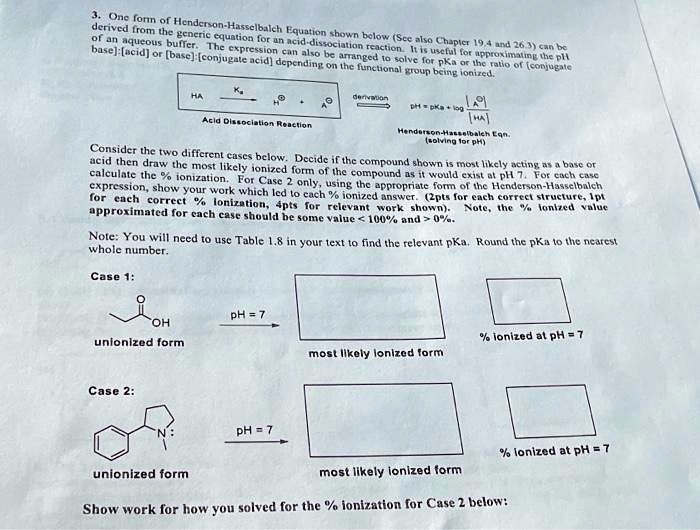
3. One form of Henderson-Hasselbalch Equation shown below (See also Chapter 19.4 and 26.3) can be
derived from the generic equation for an acid-dissociation reaction. It is useful for approximating the pH
of an aqueous buffer. The expression can also be arranged to solve for pKa or the ratio of (conjugate
base]: [acid] or [base]:[conjugate acid] depending on the functional group being ionized.
$K_a$
HA
Acid Dissociation Reaction
derivation
$pH = pK_a + log\frac{[A^-]}{[HA]}$
Henderson-Hasselbaich Eqn.
(solving for pH)
Consider the two different cases below. Decide if the compound shown is most likely acting as a base or
acid then draw the most likely ionized form of the compound as it would exist at pH 7. For each case
calculate the % ionization. For Case 2 only, using the appropriate form of the Henderson-Hasselbalch
expression, show your work which led to each % ionized answer. (2pts for each correct structure, 1pt
for each correct % ionization, 4pts for relevant work shown). Note, the % ionized value
approximated for each case should be some value < 100% and > 0%.
Note: You will need to use Table 1.8 in your text to find the relevant pKa. Round the pKa to the nearest
whole number.
Case 1:
$pH = 7$
OH
unionized form
% ionized at pH = 7
most likely ionized form
Case 2:
$N^+$:
$pH = 7$
% ionized at pH = 7
unionized form
most likely ionized form
Show work for how you solved for the % ionization for Case 2 below: