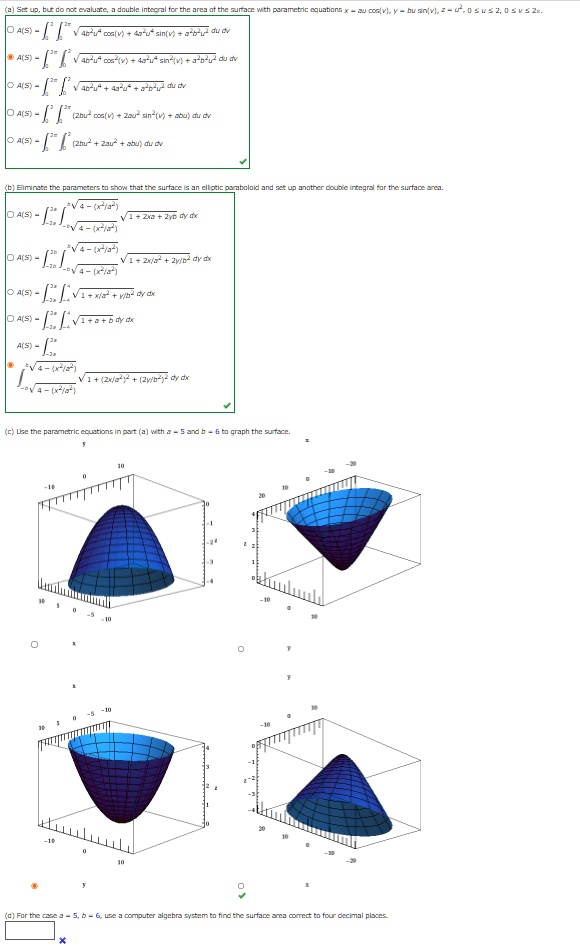
(a) Set up, but do not evaluate, a double integral for the area of the surface with parametric equations $x = au \cos(v)$, $y = bu \sin(v)$, $z = u^2$, $0 \le u \le 2$, $0 \le v \le 2\pi$
OA(S) - $\int_0^2 \int_0^{2\pi} \sqrt{4b^2u \cos^2(v) + 4a^2u^2 \sin^2(v) + a^2b^2u^2} \, du \, dv$
OA(S) - $\int_0^2 \int_0^{2\pi} \sqrt{4b^2u^2 \cos(v) + 4a^2u^2 \sin(v) + a^2b^2u^2} \, du \, dv$
OA(S) - $\int_0^2 \int_0^{2\pi} \sqrt{4b^2u^2 + 4a^2u^2 + a^2b^2u^2} \, du \, dv$
OA(S) - $\int_0^2 \int_0^{2\pi} (2bu^2 \cos(v) + 2au^2 \sin^2(v) + abu) \, du \, dv$
OA(S) - $\int_0^2 \int_0^{2\pi} (2bu^2 + 2au^2 + abu) \, du \, dv$
(b) Eliminate the parameters to show that the surface is an elliptic paraboloid and set up another double integral for the surface area.
OA(S) - $\int_{-2b}^{2b} \int_{-\sqrt{4 - (y^2/b^2)}}^{\sqrt{4 - (y^2/b^2)}} \sqrt{1 + 2x/a^2 + 2y/b^2} \, dx \, dy$
OA(S) - $\int_{-2a}^{2a} \int_{-\sqrt{4 - (x^2/a^2)}}^{\sqrt{4 - (x^2/a^2)}} \sqrt{1 + 2x/a^2 + 2y/b^2} \, dy \, dx$
OA(S) - $\int_{-2a}^{2a} \int_{-\sqrt{4 - (x^2/a^2)}}^{\sqrt{4 - (x^2/a^2)}} \sqrt{1 + x/a^2 + y/b^2} \, dy \, dx$
OA(S) - $\int_{-2a}^{2a} \int_{-2b}^{2b} \sqrt{1 + a + b} \, dy \, dx$
OA(S) - $\int_{-2a}^{2a} \int_{-\sqrt{4 - (x^2/a^2)}}^{\sqrt{4 - (x^2/a^2)}} \sqrt{1 + (2x/a^2)^2 + (2y/b^2)^2} \, dy \, dx$
(c) Use the parametric equations in part (a) with $a = 5$ and $b = 6$ to graph the surface.
(d) For the case $a = 5$, $b = 6$, use a computer algebra system to find the surface area correct to four decimal places.