A
B
Slime Gate
C
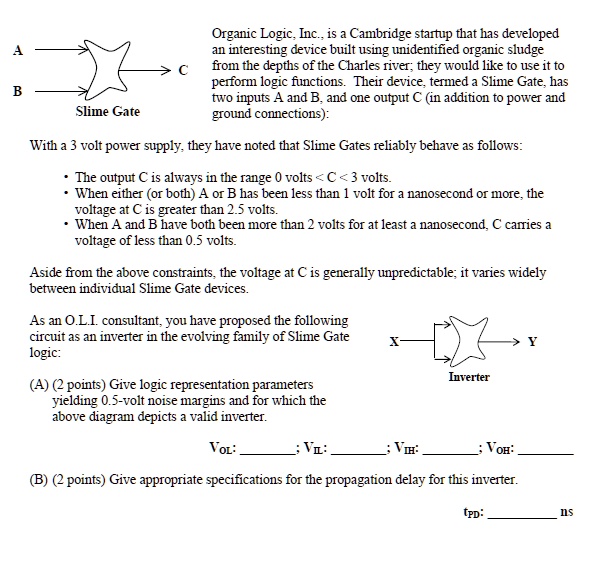
Organic Logic, Inc., is a Cambridge startup that has developed
an interesting device built using unidentified organic sludge
from the depths of the Charles river; they would like to use it to
perform logic functions. Their device, termed a Slime Gate, has
two inputs A and B, and one output C (in addition to power and
ground connections):
With a 3 volt power supply, they have noted that Slime Gates reliably behave as follows:
• The output C is always in the range 0 volts < C <3 volts.
• When either (or both) A or B has been less than 1 volt for a nanosecond or more, the
voltage at C is greater than 2.5 volts.
• When A and B have both been more than 2 volts for at least a nanosecond, C carries a
voltage of less than 0.5 volts.
Aside from the above constraints, the voltage at C is generally unpredictable; it varies widely
between individual Slime Gate devices.
As an O.L.I. consultant, you have proposed the following
circuit as an inverter in the evolving family of Slime Gate
logic:
(A) (2 points) Give logic representation parameters
yielding 0.5-volt noise margins and for which the
above diagram depicts a valid inverter.
X
Y
Inverter
VOL:
VIL:
VIH:
; VOH:
(B) (2 points) Give appropriate specifications for the propagation delay for this inverter.
PD:
ns