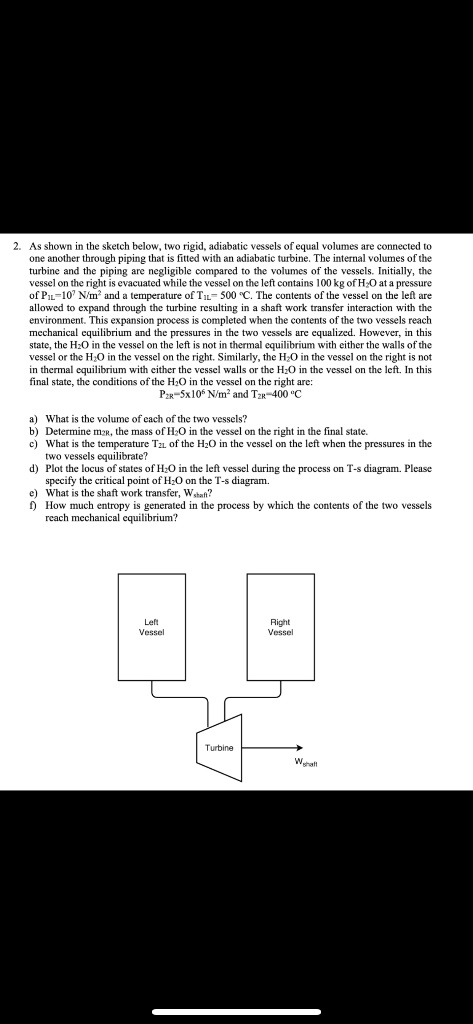
2. As shown in the sketch below, two rigid, adiabatic vessels of equal volumes are connected to
one another through piping that is fitted with an adiabatic turbine. The internal volumes of the
turbine and the piping are negligible compared to the volumes of the vessels. Initially, the
vessel on the right is evacuated while the vessel on the left contains 100 kg of H?O at a pressure
of $P_{1L}$=10? N/m² and a temperature of $T_{1L}$= 500 °C. The contents of the vessel on the left are
allowed to expand through the turbine resulting in a shaft work transfer interaction with the
environment. This expansion process is completed when the contents of the two vessels reach
mechanical equilibrium and the pressures in the two vessels are equalized. However, in this
state, the H?O in the vessel on the left is not in thermal equilibrium with either the walls of the
vessel or the H?O in the vessel on the right. Similarly, the H?O in the vessel on the right is not
in thermal equilibrium with either the vessel walls or the H?O in the vessel on the left. In this
final state, the conditions of the H?O in the vessel on the right are:
$P_{2R}$=5x10? N/m² and $T_{2R}$=400 °C
a) What is the volume of each of the two vessels?
b) Determine $m_{2R}$, the mass of H?O in the vessel on the right in the final state.
c) What is the temperature $T_{2L}$ of the H?O in the vessel on the left when the pressures in the
two vessels equilibrate?
d) Plot the locus of states of H?O in the left vessel during the process on T-s diagram. Please
specify the critical point of H?O on the T-s diagram.
e) What is the shaft work transfer, $W_{shaft}$?
f) How much entropy is generated in the process by which the contents of the two vessels
reach mechanical equilibrium?