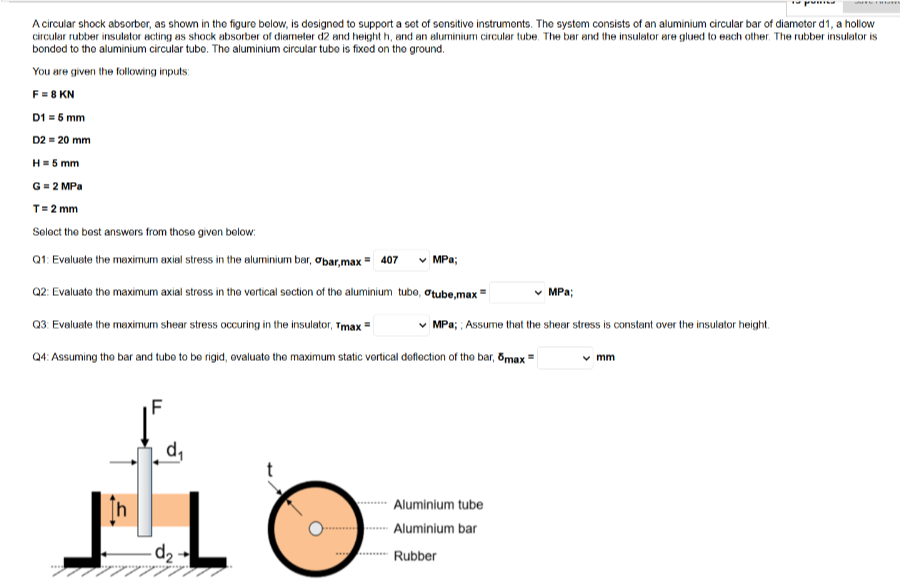
A circular shock absorber, as shown in the figure below, is designed to support a set of sonsitive instruments. The systom consists of an aluminium circular bar of diamoter d1, a hollow circular rubber insulator ecting es shock absorber of diameter \( \mathrm{d} 2 \) and height \( \mathrm{h} \), and an zluminium circular tube. The bar arkd the insulator are glued to each other. The rubber insulator is bondod to the aluminium circular tube. The aluminium circular tubo is fixod on the ground.
You are given the following inputs:
\[
\begin{array}{l}
F=8 \mathrm{KN} \\
D 1=5 \mathrm{~mm} \\
D 2=20 \mathrm{~mm} \\
H=5 \mathrm{~mm} \\
G=2 \mathrm{MPa} \\
T=2 \mathrm{~mm}
\end{array}
\]
Select the best answers from those given below:
Q1: Evaluate the maximum axial stress in the aluminium bar, \( \sigma_{\text {bar, }} \) max \( =407 \quad \vee \mathrm{MPa} \);
Q2: Evaluate the maximum axial stress in the vertical section of the aluminium tube, \( \sigma_{\text {tube,max }}=\quad \vee \mathrm{MPa} \);
Q3: Evaluate the maximum shear stress occuring in the insulator, \( \boldsymbol{T}_{\text {max }}= \) \( \square \) MPa; ; Assume that the shear stress is constant over the insulator height.
Q4: Assuming the bar and tube to be rigid, ovaluate the maximum static vertical deflection of the bar, \( \boldsymbol{\sigma}_{\text {max }}= \) \( \square \) \( \mathrm{mm} \)