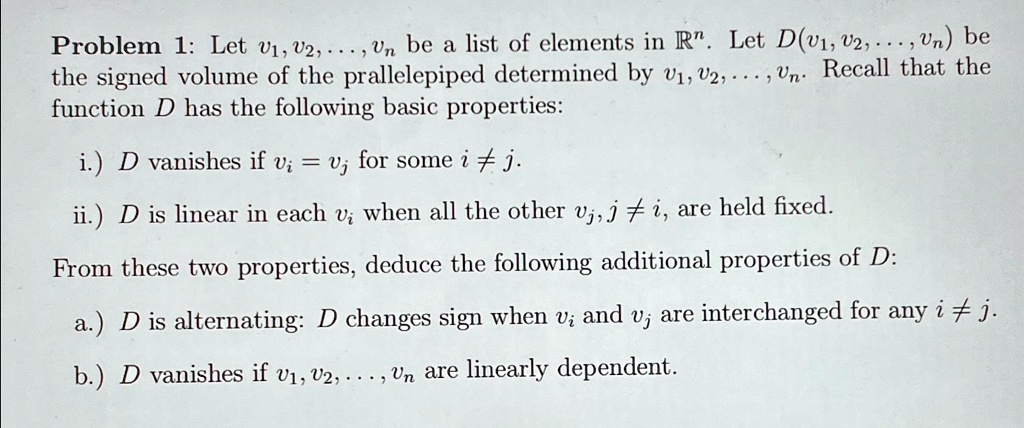
Problem 1: Let $v_1, v_2, \dots, v_n$ be a list of elements in $\mathbb{R}^n$. Let $D(v_1, v_2, \dots, v_n)$ be the signed volume of the parallelepiped determined by $v_1, v_2, \dots, v_n$. Recall that the function $D$ has the following basic properties:
i.) $D$ vanishes if $v_i = v_j$ for some $i \neq j$.
ii.) $D$ is linear in each $v_i$ when all the other $v_j, j \neq i$, are held fixed.
From these two properties, deduce the following additional properties of $D$:
a.) $D$ is alternating: $D$ changes sign when $v_i$ and $v_j$ are interchanged for any $i \neq j$.
b.) $D$ vanishes if $v_1, v_2, \dots, v_n$ are linearly dependent.