Use the following table of probabilities for the standard normal distribution to answer part of this question.
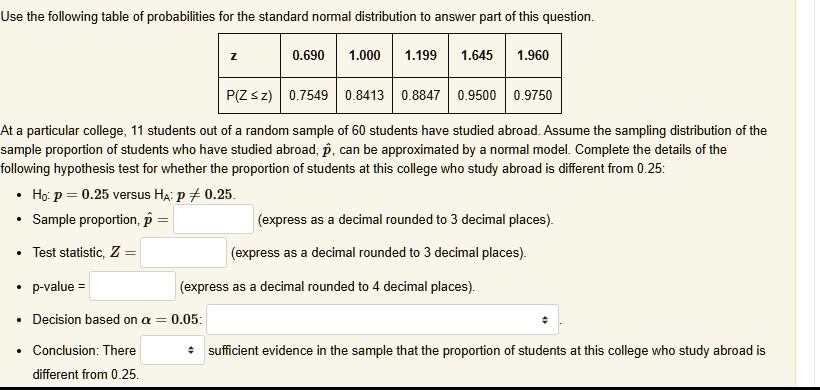
z | 0.690 | 1.000 | 1.199 | 1.645 | 1.960
P(Z $\le$ z) | 0.7549 | 0.8413 | 0.8847 | 0.9500 | 0.9750
At a particular college, 11 students out of a random sample of 60 students have studied abroad. Assume the sampling distribution of the sample proportion of students who have studied abroad, $\hat{p}$, can be approximated by a normal model. Complete the details of the following hypothesis test for whether the proportion of students at this college who study abroad is different from 0.25:
* H$_0$: p = 0.25 versus H$_A$: p $\ne$ 0.25.
* Sample proportion, $\hat{p}$ = (express as a decimal rounded to 3 decimal places).
* Test statistic, Z = (express as a decimal rounded to 3 decimal places).
* p-value = (express as a decimal rounded to 4 decimal places).
* Decision based on $\alpha$ = 0.05:
* Conclusion: There sufficient evidence in the sample that the proportion of students at this college who study abroad is different from 0.25.