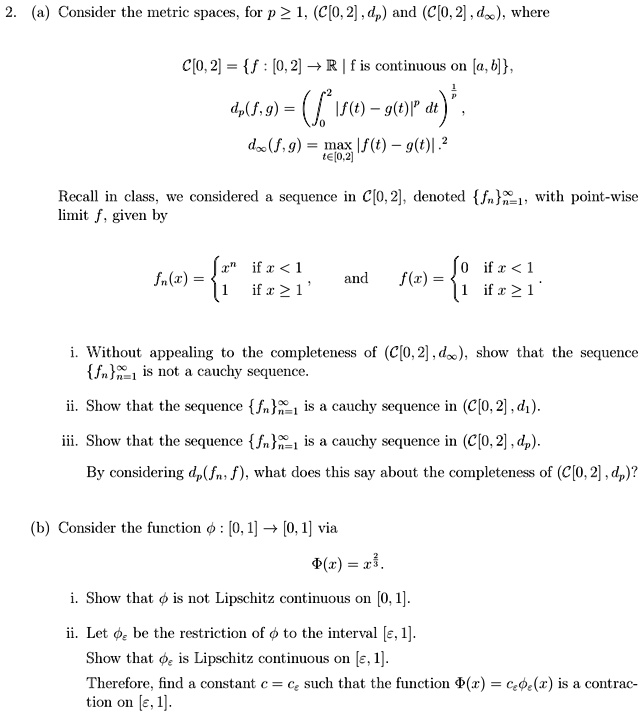
(a) Consider the metric spaces, for p >= 1, (C[0,2], d_(p)) and (C[0,2], d_(∞)), where
C[0,2] = {f: [0,2] -> R | f is continuous on [a,b]}
d_(p)(f,g) = (∫₀² |f(t) - g(t)|^p dt)^(1/p)
d_(∞)(f,g) = max_{t in [0,2]} |f(t) - g(t)|^2
Recall in class, we considered a sequence in C[0,2], denoted {f_n}_{n=1}^∞, with point-wise
limit f, given by
i. Without appealing to the completeness of (C[0,2], d_(∞)), show that the sequence
{f_n}_{n=1}^∞ is not a Cauchy sequence.
ii. Show that the sequence {f_n}_{n=1}^∞ is a Cauchy sequence in (C[0,2], d_(1)).
iii. Show that the sequence {f_n}_{n=1}^∞ is a Cauchy sequence in (C[0,2], d_(p)).
By considering d_(p)(f_n, f), what does this say about the completeness of (C[0,2], d_(p))?
(b) Consider the function φ: [0,1] -> [0,1] via
φ(x) = x^(2/3).
i. Show that φ is not Lipschitz continuous on [0,1].
ii. Let φ_ε be the restriction of φ to the interval [ε,1].
Show that φ_ε is Lipschitz continuous on [ε,1].
Therefore, find a constant c = c_ε such that the function Φ(x) = c_εφ_ε(x) is a contraction on [ε,1].