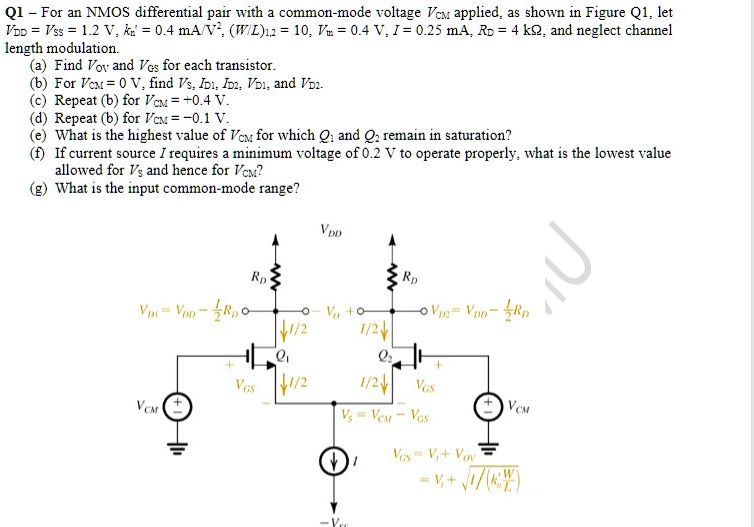
Q1 - For an NMOS differential pair with a common-mode voltage $V_{CM}$ applied, as shown in Figure Q1, let
$V_{DD} = V_{SS} = 1.2\text{ V}$, $k_n' = 0.4\text{ mA/}V^2$, $(W/L)_{1,2} = 10$, $V_m = 0.4\text{ V}$, $I = 0.25\text{ mA}$, $R_D = 4\text{ k}\Omega$, and neglect channel
length modulation.
(a) Find $V_{OV}$ and $V_{GS}$ for each transistor.
(b) For $V_{CM} = 0\text{ V}$, find $V_S$, $I_{D1}$, $I_{D2}$, $V_{D1}$, and $V_{D2}$.
(c) Repeat (b) for $V_{CM} = +0.4\text{ V}$.
(d) Repeat (b) for $V_{CM} = -0.1\text{ V}$.
(e) What is the highest value of $V_{CM}$ for which $Q_1$ and $Q_2$ remain in saturation?
(f) If current source $I$ requires a minimum voltage of 0.2 V to operate properly, what is the lowest value
allowed for $V_S$ and hence for $V_{CM}$?
(g) What is the input common-mode range?