Ace - AI Tutor
Ask Our Educators
Textbooks
My Library
Flashcards
Scribe - AI Notes
Notes & Exams
Download App
amanda palmer

amanda p.

Divider

Questions asked

BEST MATCH

If a 980 N net force will cause an astronaut’s tool box to accelerate at 9.8 m/s2 on Earth, then a 980 N net force will cause the same tool box to accelerate at 9.8 m/s2on the Moon. Question 3 options: TrueFalse

View Answer
divider
BEST MATCH

What is North Carolina General Statute #95-98, regarding labor rights? Question 16Select one: a. A law from the 1950's that prevents public workers (teachers, police, fire fighters, social workers, etc.) from joining together to collectively bargain with their employer--the state or local governments b. A law confirming the right of labor unions to exist in North Carolina and to bargain for worker rights

View Answer
divider
BEST MATCH

Are there any ethical issues in narrative and focus solution family therapy? citations included

View Answer
divider
BEST MATCH

The specific heat of a certain type of cooking oil is 1.75 J how much heat energy is needed to raise the temperature of 2.65 kg of this oil 23 C to 191 C

View Answer
divider
BEST MATCH

3 of 50 A client who is performing peritoneal dialysis at home calls the clinic and reports that the outflow from the dialysis catheter seems to be decreasing in amount. The clinic nurse would ask which question first?

View Answer
divider
BEST MATCH

The heme portion of the hemoglobin molecule is a pigment. True or False

View Answer
divider
BEST MATCH

Suppose that $n$ is a positive integer. Arrange the steps in the correct order to show that 2 divides $n^2 + n$ using mathematical induction. Rank the options below. $1^2 + 1 = 2$ and $2 | 2$, so the basis step is clear. 2 divides $k^2 + k$ by inductive hypothesis, and clearly 2 divides $2(k + 1)$. As the sum of two multiples of 2 is again a multiple of 2, 2 divides $(k + 1)^2 + (k + 1)$. $(k + 1)^2 + (k + 1) = (k^2 + 2k + 1) + (k + 1) = (k^2 + k) + 2(k + 1)$ The inductive hypothesis is that 2 divides $k^2 + k$.

View Answer
divider
BEST MATCH

On January 1, 2025, Sunland Company leased equipment to Carla Vista Corporation. The following information pertains to this lease. 1. The term of the non-cancelable lease is 6 years. At the end of the lease term, Carla Vista has the option to purchase the equipment for $2,000, while the expected residual value at the end of the lease is $6,000. 2. Equal rental payments are due on January 1 of each year, beginning in 2025. 3. The fair value of the equipment on January 1, 2025, is $200,000, and its cost is $150,000. 4. 5. The equipment has an economic life of 8 years. Carla Vista depreciates all of its equipment on a straight-line basis. Sunland set the annual rental to ensure a 4% rate of return. Carla Vista's incremental borrowing rate is 5%, and the implicit rate of the lessor is unknown. 6. Collectibility of lease payments by the lessor is probable. Both the lessor and the lessee's accounting periods end on December 31. Click here to view factor tables. (For calculation purposes, use 5 decimal places as displayed in the factor table provided.) (a) Indicate the nature of this lease to Sunland and Carla Vista. The nature of this lease for Sunland is a lease. The nature of this lease for Carla Vista is a lease.

View Answer
divider
BEST MATCH

The Canliss Milling Company purchased machinery on January 2, 2016, for $810,000. A five-year life was estimated and no residual value was anticipated. Canliss decided to use the straight-line depreciation method and recorded $162,000 in depreciation in 2016 and 2017. Early in 2018, the company changed its depreciation method to the sum-of-the-years'-digits (SYD) method. Required: 2. Prepare any 2018 journal entry related to the change. (If no entry is required for a transaction/event, select "No journal entry required" in the first account field.) View transaction list Journal entry worksheet < 1 > Record the adjusting entry for depreciation in 2018. Note: Enter debits before credits. Event 1 General Journal Debit Credit

View Answer
divider
BEST MATCH

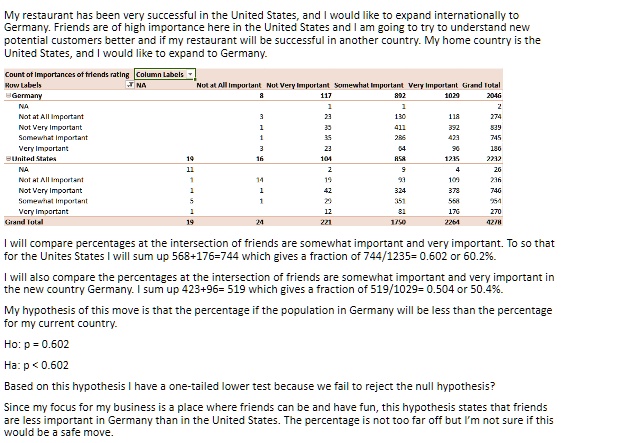
Using the data below, complete the following: Recall that: Type I error is defined as rejecting the null hypothesis when in fact it should not be rejected (i.e., "false positive," "false alarm," defendant found guilty when in fact innocent). Type II error is defined as not rejecting the null hypothesis when in fact it should be rejected (i.e., "false negative," defendant found not guilty when in fact guilty). In the context of the below hypothesis test, discuss what the type I error and type II error would mean, using a decision table as your guide. My restaurant has been very successful in the United States, and I would like to expand internationally to assess potential customers better and if my restaurant will be successful in another country. My home country is the United States, and I would like to expand to Germany. Count of Importances of friends rating [Column Labels] Row Labels TNA Not at All Important Not Very Important Somewhat Important Very Important Grand Total Germany 117 892 1029 2046 NA 2 Not at All Important 118 274 Not Very Important m m m NRM 411 539 Somewhat Important 286 745 Very Important 3 4 3 96 186 United States 19 1235 2232 NA Not at All Important Not Very Important 324 378 746 Somewhat Important 954 Very Important 270 Grand Total 19 24 221 1750 2264 4278 I will compare percentages at the intersection of friends are somewhat important and very important. To do that for the United States, I will sum up 568+176=744, which gives a fraction of 744/1235 = 0.602 or 60.2%. I will also compare the percentages at the intersection of friends are somewhat important and very important in the new country Germany. I sum up 423+96=519, which gives a fraction of 519/1029 = 0.504 or 50.4%. For my current country: Ho: p = 0.602 Ha: p < 0.602 Based on this hypothesis, I have a one-tailed lower test because we fail to reject the null hypothesis! Since my focus for my business is a place where friends can be and have fun, this hypothesis states that friends are less important in Germany than in the United States. The percentage is not too far off, but I'm not sure if this would be a safe move.
View Answer
divider