Ace - AI Tutor
Ask Our Educators
Textbooks
My Library
Flashcards
Scribe - AI Notes
Notes & Exams
Download App
amber avery

amber a.

Divider

Questions asked

BEST MATCH

13. The beginning point to a muscle is called the 14. The more movable attachment of the muscle is called the 15. To move a joint in such a way as to increase the angle of the joint is called 16. To move a joint in such a way as to decrease the angle of the joint is called 17. The muscle that goes across the forehead is called the

View Answer
divider
BEST MATCH

2. Crypts/glands are only found in the small intestine. O True O False

View Answer
divider
BEST MATCH

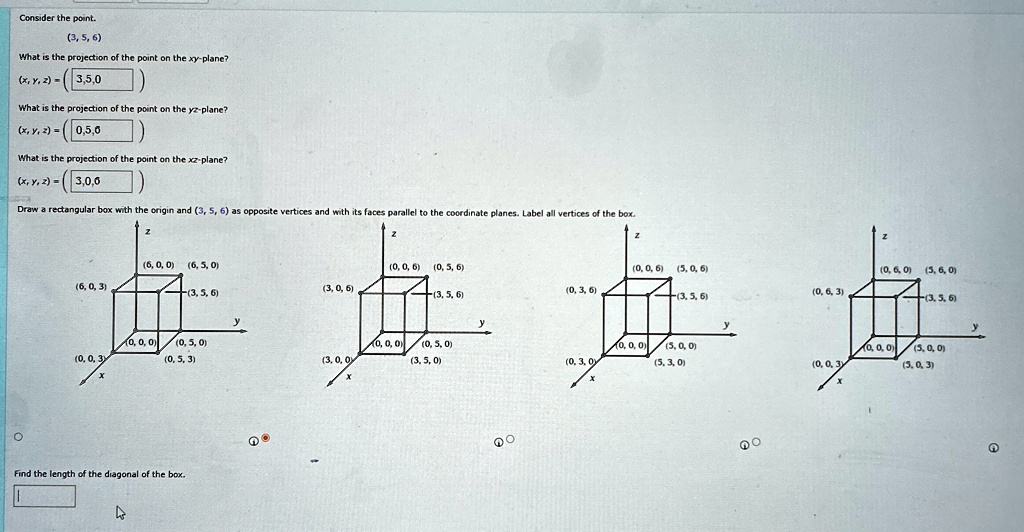
Consider the point. (3, 5, 6) What is the projection of the point on the xy-plane? $(x, y, z) = (3, 5, 0)$ What is the projection of the point on the yz-plane? $(x, y, z) = (0, 5, 6)$ What is the projection of the point on the xz-plane? $(x, y, z) = (3, 0, 6)$ Draw a rectangular box with the origin and (3, 5, 6) as opposite vertices and with its faces parallel to the coordinate planes. Label all vertices of the box. Find the length of the diagonal of the box.
View Answer
divider
BEST MATCH

Compare the number of atoms in * 1 point 1 mole of carbon-12 ( with the number of molecules in 1 mole of oxygen gas \( \left(\mathrm{O}_{2}\right) \). How do these quantities compare? The number of carbon atoms is greater. They contain the same number of particles. The number of oxygen molecules is greater. The number of carbon atoms is half of the oxygen molecules. Avogadro's number is used to * 1 point count entities such as atoms, molecules, and ions in a substance. Based on this, which of the following is not an appropriate unit to apply Avogadro's number to? I. Atom II. Molecules III. Ions IV. Grmas Avogadro's number applies only to molecules and ions. Avogadro's number can apply to atoms, molecules, and ions but not grams. Avogadro's number applies to all listed units, including grams. Avogadro's number can apply to grams but not atoms. Why is the molar mass of an * 1 point element numerically equivalent to its atomic mass? Because both represent the mass of a single atom in kilograms Because molar mass and atomic mass are two different properties with no relation Because atomic mass is measured in grams Because the atomic mass represents the mass of one mole of atoms in atomic mass units (amu), which is equivalent to molar mass in grams per mole

View Answer
divider
BEST MATCH

Rasheed works for Company A, earning $359,000 in salary during 2024. Assuming he is single and has no other sources of income, what amount of FICA tax will Rasheed pay for the year? Note: Round your intermediate and final answer to the nearest whole dollar amount.

View Answer
divider
BEST MATCH

For the function f'(x) below, find the constant of integration (the value of the + C in the indefinite integral), such that the antiderivative f(x) is such that f(6) = 15. 2x ln(x/6)

View Answer
divider
BEST MATCH

At 15°C, and 1.72 bar, 15.30 g of a compound in the gaseous state occupied a volume of 1.70 L. Calculate the molecular mass of the compound 125.2 g/mol 12685 g/mol 660.2 g/mol 112.7 g/mol 6.517 g/mol

View Answer
divider
BEST MATCH

For a particle of mass m living in 1D and under the influence of a harmonic oscillator, $U(x) = \frac{1}{2}Kx^2 = \frac{1}{2}m\omega^2x^2$, where $\omega$ is the angular frequency that characterizes the harmonic (or parabolic) potential energy function, the time-independent Schrödinger equation is $\frac{-\hbar^2}{2m}\frac{d^2}{dx^2}\psi(x) + \frac{1}{2}m\omega^2x^2\psi(x) = E\psi(x)$ (2) which is an equation to solve for many $\psi$'s and many $E$'s. In Problem 2.1, we (you) have shown that $\psi_0(x) = (\frac{m\omega}{\pi\hbar})^{1/4}e^{-\frac{mwx^2}{2\hbar}} = (\frac{m\omega}{\pi\hbar})^{1/4}exp(-\frac{m\omega x^2}{2\hbar})$ (3) is the ground state solution with eigenvalue (energy) $\hbar\omega/2$. In Problems 1.4 and 2.2, you did some integrals that could be re-cycled here. Expectation value involves two pieces of information: the quantity of interest represented by an operator A and the state $\Psi$ that measurements are made. The expectation value is then given by $(A) = \int \Psi^*\hat{A}\Psi dx$ (4) and the variance is $(\Delta A)^2 = (A^2) - (A)^2$ (5) where $\Delta A$ is the uncertainty. (a) Evaluate the expectation value of position ($x$) and the uncertainty of position $\Delta x$ for the harmonic oscillator ground state. (b) Evaluate the expectation value of momentum ($p$) and the uncertainty of momentum $\Delta p$ for the harmonic oscillator ground state. (c) Hence, evaluate $\Delta x \cdot \Delta p$. Comment on the result in light of Heisenberg's uncertainty relation $\Delta x \Delta p \ge \hbar/2$. [Remark: You have played with the 1D harmonic oscillator in every Problem Set. You could repeat the problems for other harmonic oscillator energy eigenstates, after we solve TISE in the next chapter.

View Answer
divider
BEST MATCH

9. Using the Routh-Hurwitz criterion and the unity feedback system of Figure 1 with $G(s) = \frac{1}{2s^4 + 5s^3 + s^2 + s + 2s}$ Tell whether or not the closed-loop system is stable. Figure 1 A unity feedback system.

View Answer
divider
BEST MATCH

4B - Graded ????:01:30:11 Consider a stock that will have dividend growth rates in the next three periods of 9%, 10%, and 3%, respectively. The third growth rate remains forever. The company just paid a dividend, $D_0$, of $1.19. The interest rate is 12%. How much are the dividends in periods 1, 2, and 3? Enter your answers rounded to 2 DECIMAL PLACES. $D_1$ = ?? $D_2$ = ?? $D_3$ = ?? Click \"Verify\" to proceed to the next part of the question. ????1???1? ??

View Answer
divider