4.1 Pumping of three-level laser systems
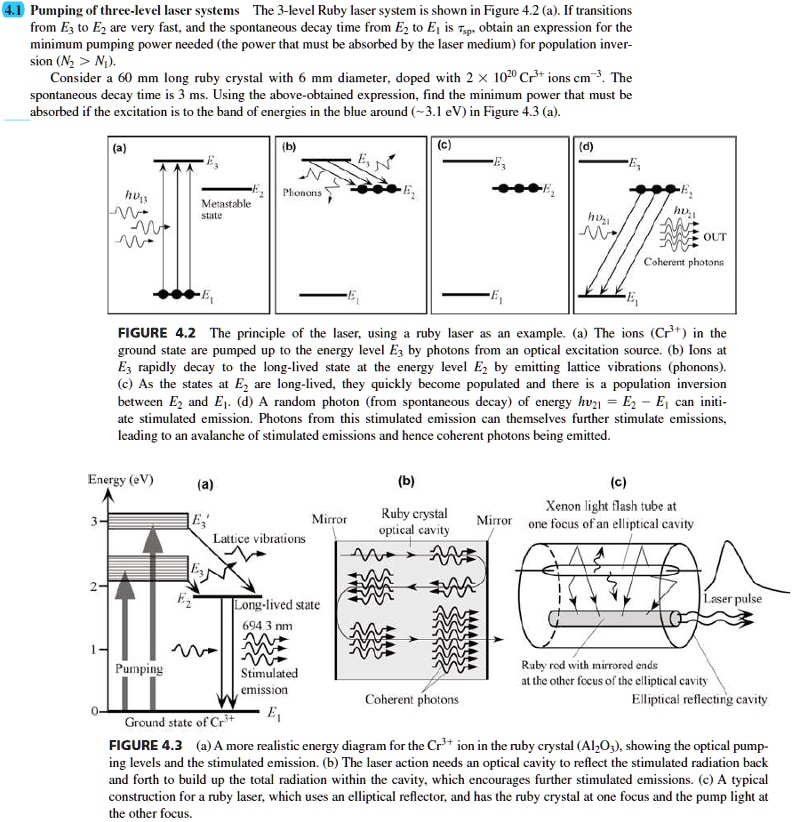
The 3-level Ruby laser system is shown in Figure 4.2 (a). If transitions from E to E are very fast, and the spontaneous decay time from E to E is Tsp, obtain an expression for the minimum pumping power needed (the power that must be absorbed by the laser medium) for population inversion (N > N). Consider a 60 mm long ruby crystal with 6 mm diameter, doped with 2 x 10^20 Cr3+ ions cm^3. The spontaneous decay time is 3 ms. Using the above-obtained expression, find the minimum power that must be absorbed if the excitation is to the band of energies in the blue around (~3.1 eV) in Figure 4.3 (a).
(a)
(b)
(c)
(d)
hois MV M
Photons
Metastable state
ho,
OUT
Coherent photons
FIGURE 4.2 The principle of the laser, using a ruby laser as an example. a The ions (Cr3+ in the ground state are pumped up to the energy level E by photons from an optical excitation source. (b) Ions at E rapidly decay to the long-lived state at the energy level E by emitting lattice vibrations (phonons). (c) As the states at E are long-lived, they quickly become populated and there is a population inversion between E and E. (d) A random photon (from spontaneous decay) of energy hui = E - E can initiate stimulated emission. Photons from this stimulated emission can themselves further stimulate emissions, leading to an avalanche of stimulated emissions and hence coherent photons being emitted.
Energy (eV)
(a)
(b)
(c)
Ruby crystal optical cavity
Xenon light flash tube at
Mirror Mirror one focus of an elliptical cavity Lattice vibrations A MM A
VAVA
Long-lived state 694.3 nm
Pulse
Pumping
Ruby rod with mirrored ends Stimulated at the other focus of the elliptical cavity emission Coherent photons Elliptical reflecting cavity E Ground state of Cr3+ FIGURE 4.3 (a) A more realistic energy diagram for the Cr3+ ion in the ruby crystal (AlO3), showing the optical pumping levels and the stimulated emission. (b) The laser action needs an optical cavity to reflect the stimulated radiation back and forth to build up the total radiation within the cavity, which encourages further stimulated emissions. (c) A typical construction for a ruby laser, which uses an elliptical reflector, and has the ruby crystal at one focus and the pump light at the other focus.