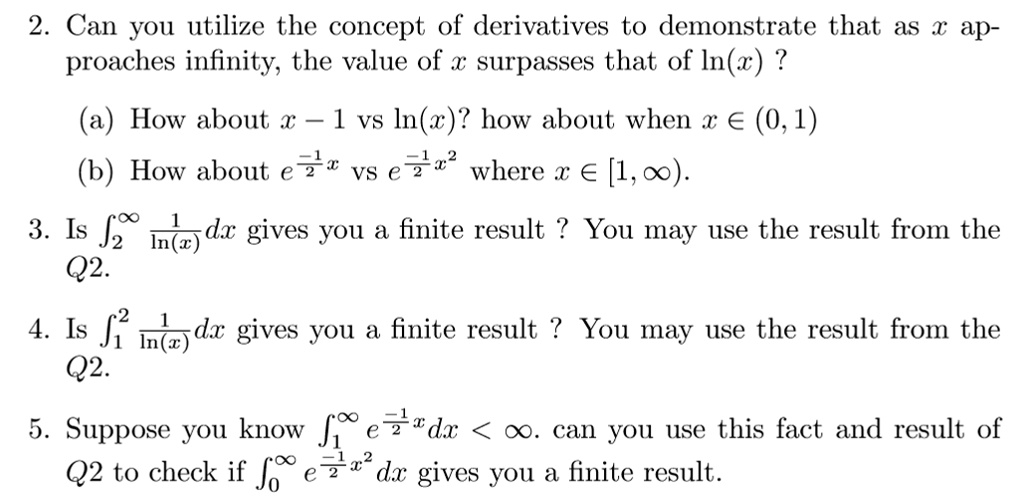
2. Can you utilize the concept of derivatives to demonstrate that as x approaches infinity, the value of x surpasses that of ln(x)?
(a) How about $x - 1$ vs ln(x)? how about when $x \in (0, 1)$
(b) How about $e^{\frac{-1}{2}x}$ vs $e^{\frac{-1}{2}x^2}$ where $x \in [1, \infty)$.
3. Is $\int_2^{\infty} \frac{1}{ln(x)}dx$ gives you a finite result ? You may use the result from the
Q2.
4. Is $\int_1^2 \frac{1}{ln(x)}dx$ gives you a finite result ? You may use the result from the
Q2.
5. Suppose you know $\int_0^{\infty} e^{\frac{-1}{2}x}dx < \infty$. can you use this fact and result of
Q2 to check if $\int_0^{\infty} e^{\frac{-1}{2}x^2}dx$ gives you a finite result.