Ace - AI Tutor
Ask Our Educators
Textbooks
My Library
Flashcards
Scribe - AI Notes
Notes & Exams
Download App
amber gonzalez

amber g.

Divider

Questions asked

BEST MATCH

2. In the tripeptide structure below, i. Label the alpha carbon with a * and box the peptide bonds. ii. Identify the amino acids that makes up this tripeptide. iii. Circle the R groups and classify them as polar, nonpolar, acidic, hydrophobic, ionic, etc... iv. How many hydrolysis reaction is required to obtain the individual amino acids.

View Answer
divider
BEST MATCH

Photorespiration occurs when rubisco Binds to CO2.Is used to generate ATP Binds to 02 Denatures

View Answer
divider
BEST MATCH

Species often develop traits that help them survive and thrive in their environments. For example, desert plants have thick leaves to store water, allowing them to survive in hot, dry climates. Give an example of an adaptive trait in an animal, plant, or microorganism, and explain how it helps the organism survive.

View Answer
divider
BEST MATCH

When a depressed individual suddenly experiences a significant, inexplicable lightening of mood, the mood change is usually indicative of a move toward better psychological health.

View Answer
divider
BEST MATCH

If you buy a new bicycle for $363 and the sales tax is 11%, what is your total bill? The total bill is $ (Round to the nearest cent as needed.)

View Answer
divider
BEST MATCH

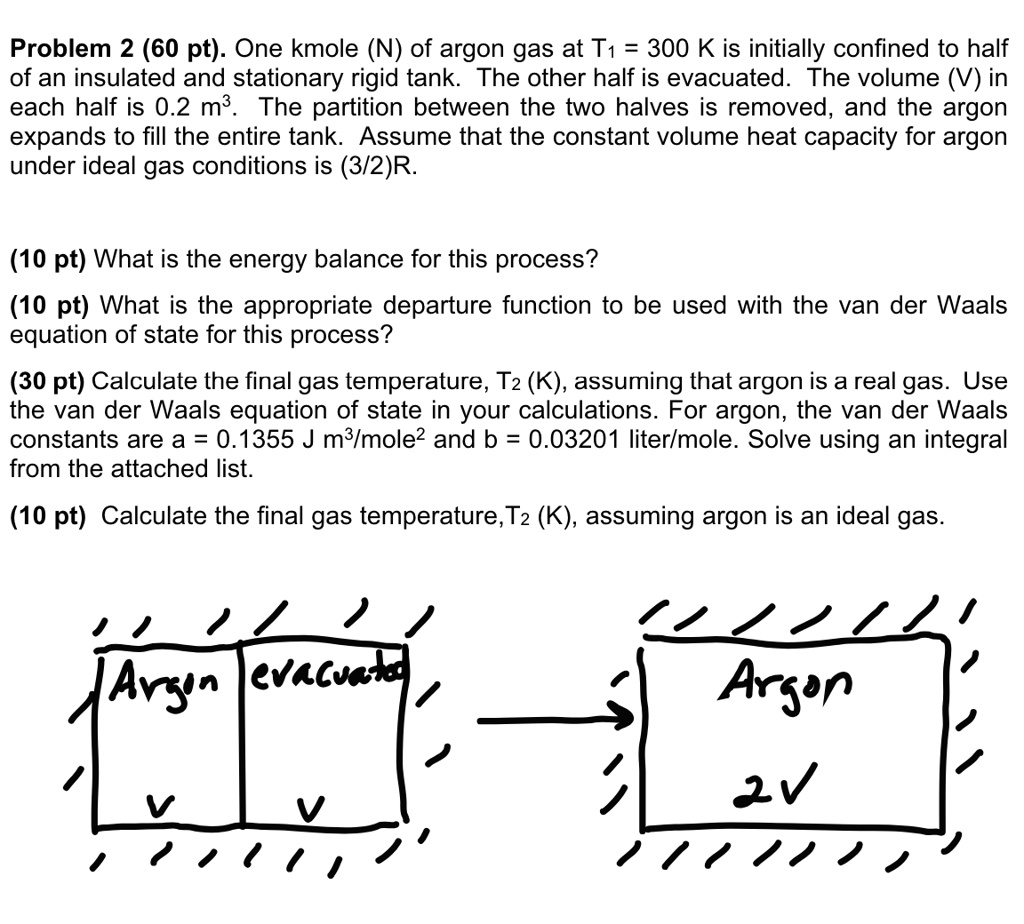
Problem 2 (60 pt). One kmole ( N ) of argon gas at T_(1)=300K is initially confined to half of an insulated and stationary rigid tank. The other half is evacuated. The volume (V) in each half is 0.2m^(3). The partition between the two halves is removed, and the argon expands to fill the entire tank. Assume that the constant volume heat capacity for argon under ideal gas conditions is ((3)/(2))R. (10 pt) What is the energy balance for this process? (10 pt) What is the appropriate departure function to be used with the van der Waals equation of state for this process? (30 pt) Calculate the final gas temperature, T_(2)(K), assuming that argon is a real gas. Use the van der Waals equation of state in your calculations. For argon, the van der Waals constants are a=0.1355J(m^(3))/(m)ole^(2) and b=0.03201 liter/mole. Solve using an integral from the attached list. (10 pt) Calculate the final gas temperature, T_(2)(K), assuming argon is an ideal gas. Problem 2 (60 pt). One kmole (N) of argon gas at T1 = 300 K is initially confined to half of an insulated and stationary rigid tank. The other half is evacuated. The volume (V) in each half is 0.2 m3. The partition between the two halves is removed, and the argon expands to fill the entire tank. Assume that the constant volume heat capacity for argon under ideal gas conditions is (3/2)R (10 pt) What is the energy balance for this process? (10 pt) What is the appropriate departure function to be used with the van der Waals equation of state for this process? (3o pt) Calculate the final gas temperature, T2 (K), assuming that argon is a real gas. Use the van der Waals eguation of state in your calculations. For argon, the van der Waals constants are a = 0.1355 J m3/mole2 and b = 0.03201 liter/mole. Solve using an integral from the attached list. 1o pt) Calculate the final gas temperature,T2 (K), assuming argon is an ideal gas evacva Arson 2 V
View Answer
divider
BEST MATCH

4. For each series, determine all integer values of k (if an (Note: For part b assume that k > 0 since otherwise the a. Ex=1 b. Σ. 1 sin n n nk (-n-k)n+k (n+k)!

View Answer
divider
BEST MATCH

Simplify the following into a single logarithm: 3log(6) + 2log(x) $\log(\frac{3 \cdot 6}{2x})$ $\log(\frac{6^3}{x^2})$ $\log(6^3x^2)$ $\log(3 \cdot 6 \cdot x^2)$ $\log(3 \cdot 6 \cdot 2x)$

View Answer
divider
BEST MATCH

4. Describe what you think may be the most interesting and useful new input or output techniques that were discussed in class. Explain why you find it the most interesting and why you think it will be the most useful.

View Answer
divider
BEST MATCH

A non-homogeneous soil deposit consists of a silt layer sandwiched between a fine-sand layer at top and a clay layer below. Permeability of the silt layer is 10 times the permeability of the clay layer and one-tenth of the permeability of the sand layer. Thickness of the silt layer is 2 times the thickness of the sand layer and two-third of the thickness of the clay layer. The ratio of equivalent horizontal and equivalent vertical permeability of the deposit is

View Answer
divider