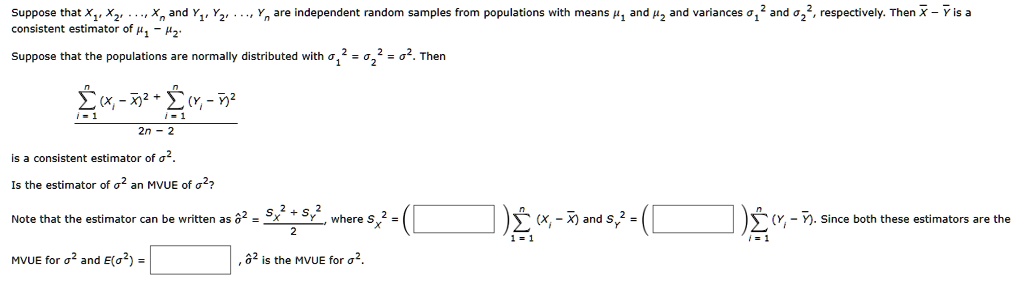
Suppose that $X_1, X_2, \dots, X_n$ and $Y_1, Y_2, \dots, Y_n$ are independent random samples from populations with means $\mu_1$ and $\mu_2$ and variances $\sigma_1^2$ and $\sigma_2^2$, respectively. Then $\bar{X} - \bar{Y}$ is a consistent estimator of $\mu_1 - \mu_2$.
Suppose that the populations are normally distributed with $\sigma_1^2 = \sigma_2^2 = \sigma^2$. Then
$\frac{\sum_{i=1}^{n} (X_i - \bar{X})^2 + \sum_{i=1}^{n} (Y_i - \bar{Y})^2}{2n - 2}$
is a consistent estimator of $\sigma^2$.
Is the estimator of $\sigma^2$ an MVUE of $\sigma^2$?
Note that the estimator can be written as $\hat{\sigma}^2 = \frac{S_X^2 + S_Y^2}{2}$, where $S_X^2 = \left(\boxed{\qquad}\right) \sum_{i=1}^{n} (X_i - \bar{X})$ and $S_Y^2 = \left(\boxed{\qquad}\right) \sum_{i=1}^{n} (Y_i - \bar{Y})$. Since both these estimators are the
MVUE for $\sigma^2$ and $E(\hat{\sigma}^2) = \boxed{\qquad}$, $\hat{\sigma}^2$ is the MVUE for $\sigma^2$.