Ace - AI Tutor
Ask Our Educators
Textbooks
My Library
Flashcards
Scribe - AI Notes
Notes & Exams
Download App
amy barcel-

amy b.

Divider

Questions asked

BEST MATCH

For a standardized normal distribution, calculate the probabilities below. a. P(z<1.1) b. P(z>=0.75) c. ◻P(z<1.1)=◻P(z>=0.75)=◻◻

View Answer
divider
BEST MATCH

Question Kremena's bank account earns \( 4.5 \% \) simple interest. How much must she deposit in the account today if she wants it to be worth \( \$ 1,250 \) in 3 years? Give your answer in dollars to the nearest dollar. Do not include the dollar symbol or commas in your answer.

View Answer
divider
BEST MATCH

Briefly introduce each of the five motivation theories: Drive Reduction Theory, Arousal Theory, Evolutionary Theory of Emotion, Maslow's Theory, and Cognitive Dissonance Theory. Apply one of the five motivation theories to each scenario (two theories total), analyzing how the theory explains and influences motivation in that particular context. Discuss the key factors, mechanisms, or processes proposed by the theory that contribute to the motivation observed in the scenarios. Provide specific examples or evidence to support your analysis.

View Answer
divider
BEST MATCH

Discuss why we need to do adjusting entries for sales returns and allowances.

View Answer
divider
BEST MATCH

Find the pressure of a 32.5 mol sample of ideal gas at 364 K which fills 0.061 $m^3$. Pa

View Answer
divider
BEST MATCH

As an alternative to the model of constant discount rates, consider the model with constant cost of delay: ui(xi, t) = xi - cit with ci > 0. I.e., in each round, players have to pay a fixed waiting cost ci. Consider the case c2 > c1, i.e. waiting is more expensive for player 2. Here, we consider the situation where the waiting cost ci is only paid in case of an agreement. Assume the game lasts for only one round. I.e., player 1 makes a proposal. If this proposal is not accepted, the game ends and both players obtain zero (they don't pay waiting cost ci in this case). Find the subgame perfect equilibrium of the game. Assume the game lasts for two rounds. I.e., player 1 makes a proposal. If player 2 accepts, the game ends. Otherwise, player 2 makes a proposal. If player 1 does not accept, the game ends and both players obtain zero (they don't pay waiting cost ci in this case). Find the subgame perfect equilibrium of the game. Assume the game lasts for three rounds. I.e., player 1 makes a proposal. If player 2 accepts, the game ends. Otherwise, player 2 makes a proposal. If player 1 accepts, the game ends. Otherwise, player 1 makes a proposal. If player 2 does not accept, the game ends and both players obtain zero (they don't pay waiting cost ci in this case). Find the subgame perfect equilibrium of the game.

View Answer
divider
BEST MATCH

14) Determine the (a) Volume and (b) Surface Area of the 3-dimensional figures. Use the is symbol and round to the nearest hundredth. 10 in 15) Determine the (a) Volume and (b) Surface Area of the 3-dimensional figures. Use the symbol and round to the nearest hundredth. -126- EXTRA CREDIT: Write the letter of your choice. (2 points each) 1. A basketball court is a rectangle that is 94 ft long and 50 ft wide. If you were to walk around the outside edge of a basketball court, how far would you walk? A. 144 ft B. 224 ft C. 288 D. 50 ft 2. How many cubic centimeters of water will a rectangular fish tank hold if the tank is 80 cm long, 50 wide and 30 cm high? A. 4,000 cubic centimeters C. 1,500 cubic centimeters B. 24,000 cubic centimeters D. 120,000 cubic centimeters

View Answer
divider
BEST MATCH

The market price of a security is $76. Its expected rate of return is 13%. The risk-free rate is 7%, and the market risk premium is 10%. What will the market price of the security be if its beta doubles (and all other variables remain unchanged)? Assume the stock is expected to pay a constant dividend in perpetuity. (Round your answer to 2 decimal places.)

View Answer
divider
BEST MATCH

Questions 1 to 4 are based on the following information Three identical point charges, Q, are placed at the vertices of an equilateral triangle as shown in the figure. The length of each side of the triangle is d. ? d d ? d Question 1 The magnitude and direction of the total electrostatic force F on the charge at the top of the triangle are $Q^2\sqrt{3} (1) F = \frac{ }{4\pi\epsilon_0 d^2}$ directed downward. $Q^2\sqrt{3} (2) F = \frac{ }{4\pi\epsilon_0 d^2}$ directed upward. $Q^2 (3) F = \frac{ }{4\pi\epsilon_0 d^2}$ directed upward. $Q^2 (4) F = \frac{ }{4\pi\epsilon_0 d^2}$ directed downward. (5) None of the above. [9 marks] 1 Please note that the factor $\frac{1}{4\pi\epsilon_0} \approx 9 \times 10^9$ is the common factor that enters the calculation of the electrostatic force. It therefore has nothing to do with the triangle above. 3

View Answer
divider
BEST MATCH

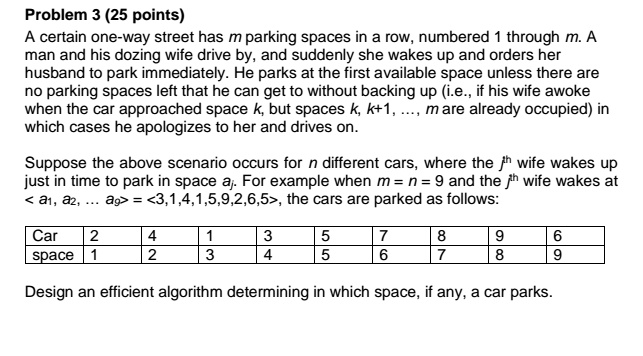
Problem 3 (25 points) A certain one-way street has m parking spaces in a row, numbered 1 through m. A man and his dozing wife drive by, and suddenly she wakes up and orders her husband to park immediately. He parks at the first available space unless there are no parking spaces left that he can get to without backing up (i.e., if his wife awoke when the car approached space k, but spaces k, k+1, ..., m are already occupied) in which cases he apologizes to her and drives on. Suppose the above scenario occurs for n different cars, where the $j^{th}$ wife wakes up just in time to park in space $a_j$. For example when $m = n = 9$ and the $j^{th}$ wife wakes at $< a_1, a_2, \dots, a_9 > = <3,1,4,1,5,9,2,6,5>$, the cars are parked as follows: Car 2 4 1 3 5 7 8 9 6 space 1 2 3 4 5 6 7 8 9 Design an efficient algorithm determining in which space, if any, a car parks.
View Answer
divider