1. Manufacturing: Labour versus Freight Cost
Consider a manufacturing firm that exports its output from a port in the city center
and employs workers who live in a suburb six miles from the center. The daily
freight cost is $9 per mile. The firm's daily labour cost increases from $20 at the
suburb to $50 at the center.
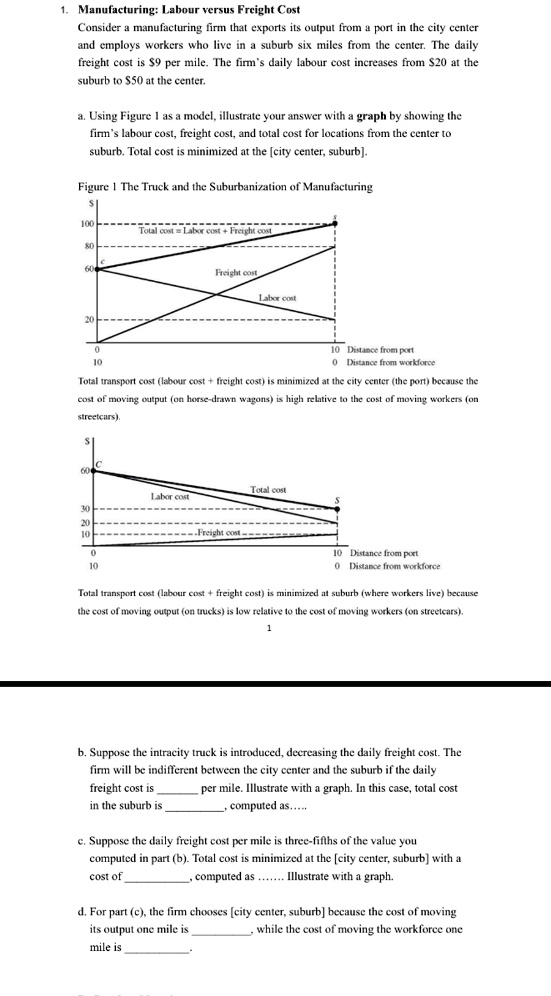
a. Using Figure 1 as a model, illustrate your answer with a graph by showing the
firm's labour cost, freight cost, and total cost for locations from the center to
suburb. Total cost is minimized at the [city center, suburb].
Figure 1 The Truck and the Suburbanization of Manufacturing
S
100
Total cost = Labor cost + Freight cost
80
60
Freight cost
Labor cost
20
10
10 Distance from port
0 Distance from workforce
Total transport cost (labour cost + freight cost) is minimized at the city center (the port) because the
cost of moving output (on horse-drawn wagons) is high relative to the cost of moving workers (on
streetcars).
S
60
Total cost
Labor cost
30
20
Freight cost
10
10
10 Distance from port
0 Distance from workforce
Total transport cost (labour cost + freight cost) is minimized at suburb (where workers live) because
the cost of moving output (on trucks) is low relative to the cost of moving workers (on streetcars).
1
b. Suppose the intracity truck is introduced, decreasing the daily freight cost. The
firm will be indifferent between the city center and the suburb if the daily
freight cost is _______ per mile. Illustrate with a graph. In this case, total cost
in the suburb is _______ computed as.....
c. Suppose the daily freight cost per mile is three-fifths of the value you
computed in part (b). Total cost is minimized at the [city center, suburb] with a
cost of _______ computed as _______. Illustrate with a graph.
d. For part (c), the firm chooses [city center, suburb] because the cost of moving
its output one mile is _______ while the cost of moving the workforce one
mile is _______.