Ace - AI Tutor
Ask Our Educators
Textbooks
My Library
Flashcards
Scribe - AI Notes
Notes & Exams
Download App
amy kim

amy k.

Divider

Questions asked

BEST MATCH

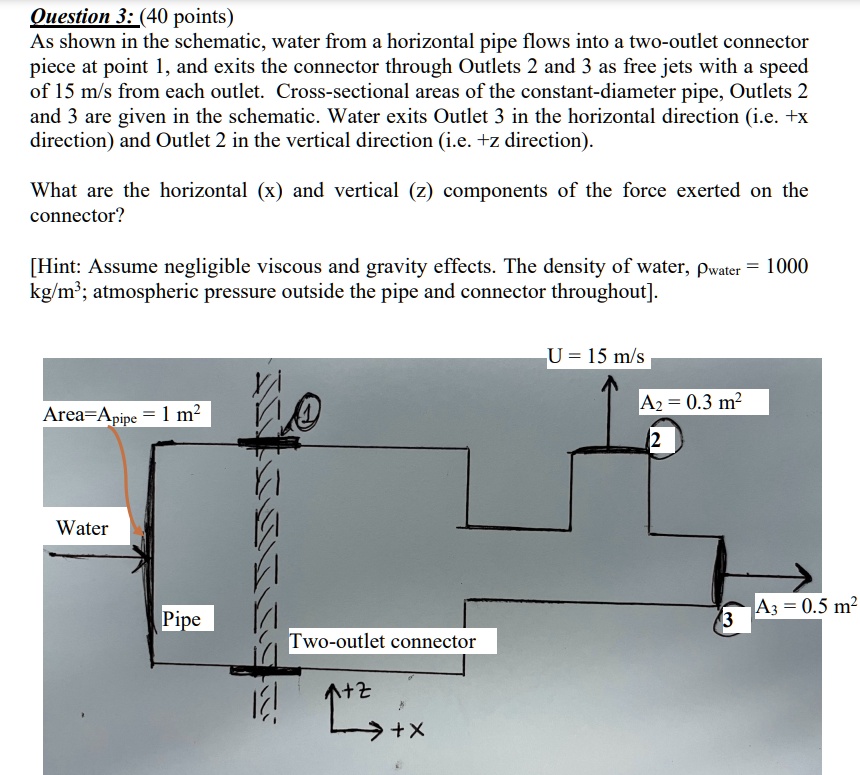
Question 3: (40 points) As shown in the schematic, water from a horizontal pipe flows into a two-outlet connector piece at point 1, and exits the connector through Outlets 2 and 3 as free jets with a speed of 15 m/s from each outlet. Cross-sectional areas of the constant-diameter pipe, Outlets 2 and 3 are given in the schematic. Water exits Outlet 3 in the horizontal direction (i.e. +x direction) and Outlet 2 in the vertical direction (i.e. +z direction). What are the horizontal (x) and vertical (z) components of the force exerted on the connector? [Hint: Assume negligible viscous and gravity effects. The density of water, $\rho_{water} = 1000$ kg/m³; atmospheric pressure outside the pipe and connector throughout]. Area=$A_{pipe} = 1 m^2$ U = 15 m/s $A_2 = 0.3 m^2$ $A_3 = 0.5 m^2$
View Answer
divider
BEST MATCH

In an electrostatic field explain why all the parts of the conductor are the same potential

View Answer
divider
BEST MATCH

Q6 The ______ was the first law implemented to rectify wage discrimination between men and women. The Civil Rights Act of 1964 Anti-Discrimination Policy Equal Opportunity Federal Policy The Equal Pay Act of 1963

View Answer
divider
BEST MATCH

in java 23.7 (Advanced: Multithreading Terms) Discuss each of the following terms in the context of Java’s threading mechanisms: synchronized wait notify notifyAll Lock Condition

View Answer
divider
BEST MATCH

4. You perform the following chemical reaction: Cu(s) + 2 AgNO3 (ag) - Cu(NO3)2 (ag) + 2 Ag (s) a) If you begin with 1.95 grams of solid copper and react it with 12.22 g of AgNOs, what is the theoretical yield for this reaction? b) Which chemical is in excess? How much is left over, in grams? c) If you obtain 1.31 grams of solid silver, what is your % yield?

View Answer
divider
BEST MATCH

You decide to borrow $19,000 to put in a new swimming pool. You obtain a loan for 20 years, making equal monthly payments. After how many years will the greatest amount of your payment be going toward principal? 15 years 1 year 5 years 19 years

View Answer
divider
BEST MATCH

3. A depression scale measures level of depression based on a survey with a mean of 15 and a standard deviation of 3. Complete the computation below and briefly state what each z- score means. a. Compute the Z score for someone who scores a 15. b. Compute the Z score for someone who scores a 22.5. c. Compute the Z score for someone who scores a 16.75. d. Compute the Z score for someone who scores a 6.84. 4. Dr. Waples wants to study level of statistics anxiety in an undergraduate statistics class. The population mean anxiety score is 25 and the standard deviation is 8. a. Compute the raw score for a Z score of 0.5. b. Compute the raw score for a Z score of 0. c. Compute the raw score for a Z score of 4. d. Compute the raw score for a Z score of 1.63.

View Answer
divider
BEST MATCH

Write an equation in slope-intercept form for the line described: x-intercept (-9,0), y-intercept (0,4).

View Answer
divider
BEST MATCH

When using the firm valuation model, the present value of the cash flows from the end of the quick growth period to infinity is called? A) The constant growth value. B) The terminal value. C) The last value. D) The final value.

View Answer
divider
BEST MATCH

Section 4-8 The Karnaugh Map 37. Draw a 3-variable Karnaugh map and label each cell according to its binary value. 38. Draw a 4-variable Karnaugh map and label each cell according to its binary value. 39. Write the standard product term for each cell in a 3-variable Karnaugh map. Section 4-9 Karnaugh Map SOP Minimization 40. Use a Karnaugh map to find the minimum SOP form for each expression: (a) $\overline{A}BC + \overline{A}B\overline{C} + A\overline{B}C$ (c) A(BC + $\overline{B}C$) + A($\overline{B}C$ + $\overline{B}\overline{C}$) 41. Use a Karnaugh map to simplify each expression to a minimum SOP form: (a) $\overline{A}BC + \overline{A}B\overline{C} + A\overline{B}C + A\overline{B}\overline{C}$ (c) DEF + $\overline{D}EF + D\overline{E}F$ (b) AC(B + C) (d) ABC + $\overline{A}BC + A\overline{B}C + A\overline{B}\overline{C}$ (b) ACB + B(B + C)

View Answer
divider