Quantum mechanics, explicit form of rotational operator
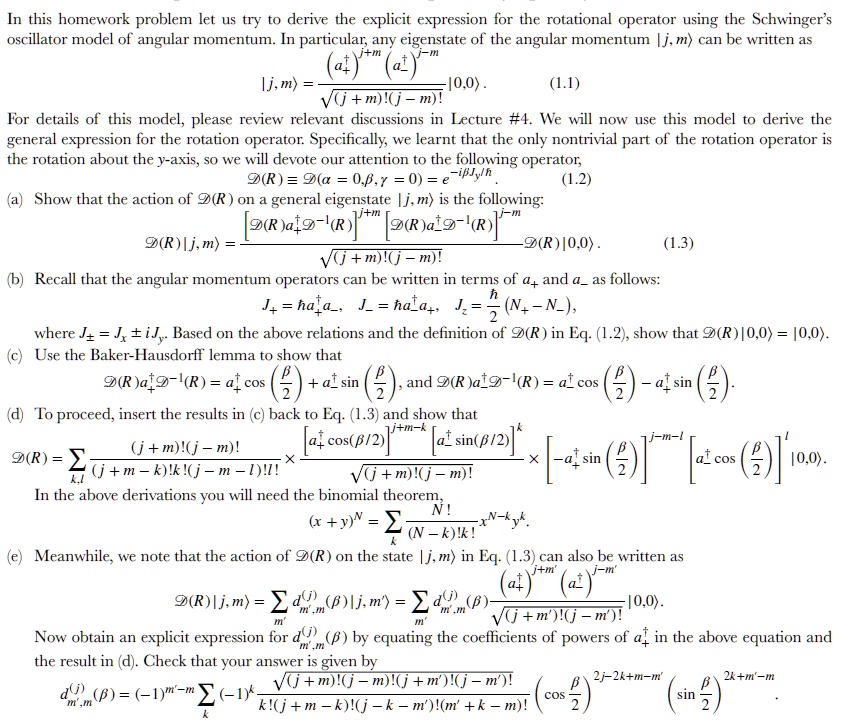
In this homework problem, let us try to derive the explicit expression for the rotational operator using the Schwinger's oscillator model of angular momentum. In particular, any eigenstate of the angular momentum (j, m) can be written as |j, m) = [0, 0) * √(j + m)! / √(j - m)! (1.1)
For details of this model, please review relevant discussions in Lecture #4. We will now use this model to derive the general expression for the rotation operator. Specifically, we learned that the only nontrivial part of the rotation operator is the rotation about the y-axis, so we will devote our attention to the following operator: (1.2)
(a) Show that the action of R on a general eigenstate (j, m) is the following: R|j, m) = R|0, 0) * √(j + m)! / √(j - m)! (1.3)
(b) Recall that the angular momentum operators can be written in terms of a+ and a- as follows:
Jx = (a+ + a-)/2
Jy = (a+ - a-)/2i
Based on the above relations and the definition of R in Eq. (1.2), show that R|0, 0) = |0, 0) (c)
(c) Use the Baker-Hausdorff lemma to show that D(R)a-1(R) = acos(θ) + a sin(θ), and (R)a-1(R) = acos(θ) - a sin(θ)
(d) To proceed, insert the results in (c) back to Eq. (1.3) and show that R|j, m) = |0, 0) * √(j + m - k)! * k! / √(j - m - l)! * l! * √(j + m)! / √(j - m)! (1.4)
In the above derivations, you will need the binomial theorem, N!
(e) Meanwhile, we note that the action of R on the state (j, m) in Eq. (1.3) can also be written as |j, m) = |0, 0) * √(j + m)! / √(j - m)! * √(2k + m - m)! / √(2k + m + m)! * sin(θ/2)^(2k + m - m) * cos(θ/2)^(2k + m + m) (1.5)
Check that your answer is given by sin(θ/2)^(2k + m - m) * cos(θ/2)^(2k + m + m) * (i^u - i^-u + i^u - i^-u) (1.6)