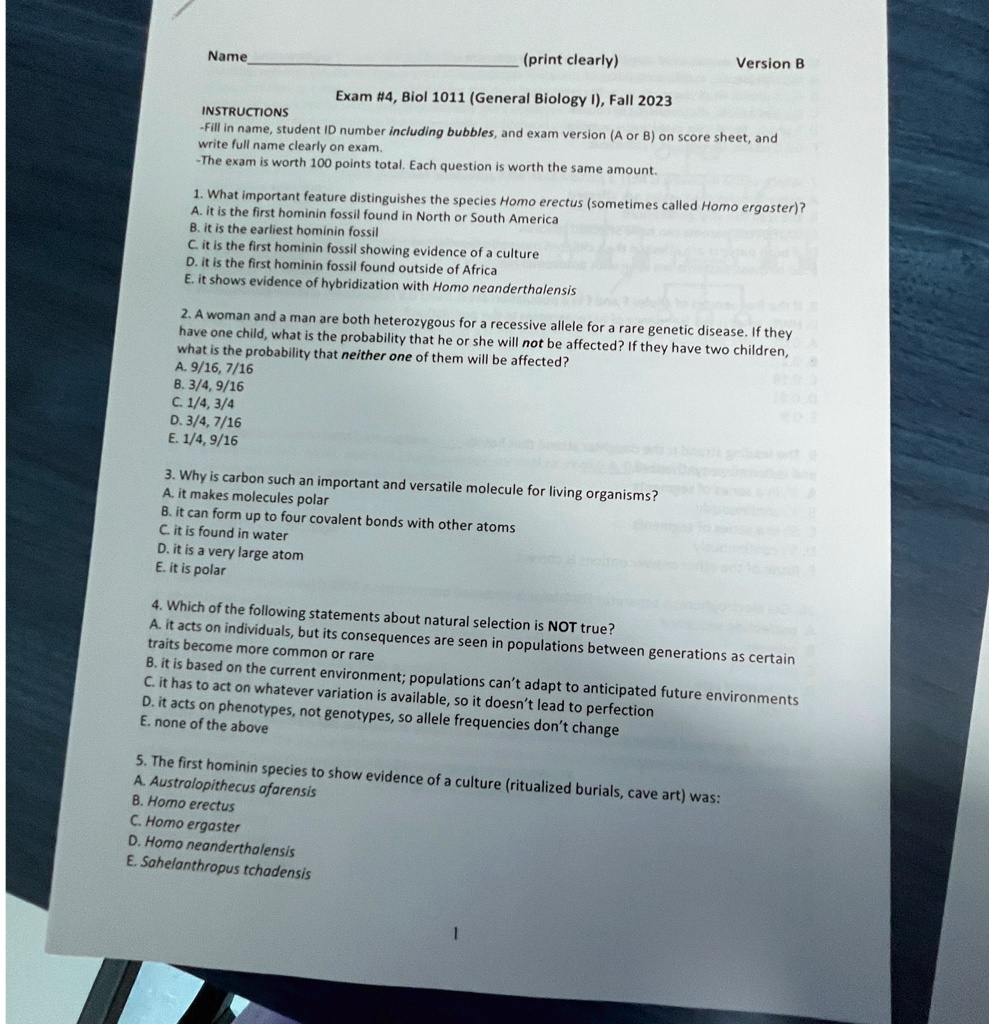
Name
(print clearly)
Version B
Exam #4, Biol 1011 (General Biology I), Fall 2023
INSTRUCTIONS
-Fill in name, student ID number including bubbles, and exam version ( A or B ) on score sheet, and write full name clearly on exam.
-The exam is worth 100 points total. Each question is worth the same amount.
What important feature distinguishes the species Homo erectus (sometimes called Homo ergaster)?
A. it is the first hominin fossil found in North or South America
B. it is the earliest hominin fossil
C. it is the first hominin fossil showing evidence of a culture
D. it is the first hominin fossil found outside of Africa
E. it shows evidence of hybridization with Homo neanderthalensis
A woman and a man are both heterozygous for a recessive allele for a rare genetic disease. If they have one child, what is the probability that he or she will not be affected? If they have two children, what is the probability that neither one of them will be affected?
A. (9)/(16),(7)/(16)
B. (3)/(4),(9)/(16)
C. (1)/(4),(3)/(4)
D. (3)/(4),(7)/(16)
E. (1)/(4),(9)/(16)
Why is carbon such an important and versatile molecule for living organisms?
A. it makes molecules polar
B. it can form up to four covalent bonds with other atoms
C. it is found in water
D. it is a very large atom
E. it is polar
Which of the following statements about natural selection is NOT true?
A. it acts on individuals, but its consequences are seen in populations between generations as certain traits become more common or rare
B. it is based on the current environment; populations can't adapt to anticipated future environments
C. it has to act on whatever variation is available, so it doesn't lead to perfection
D. it acts on phenotypes, not genotypes, so allele frequencies don't change
E. none of the above
The first hominin species to show evidence of a culture (ritualized burials, cave art) was:
A. Australopithecus afarensis
B. Homo erectus
C. Homo ergaster
D. Homo neanderthalensis
E. Sahelanthropus tchadensis
Name
(print clearly)
Version B
Exam #4,Biol 1011(General Biology I),Fall 2023
INSTRUCTIONS -Fill in name,student ID number including bubbles, and exam version (A or B) on score sheet,and write full name clearly on exam. -The exam is worth 100 points total. Each question is worth the same amount. 1.What important feature distinguishes the species Homo erectus (sometimes called Homo ergaster)? A.it is the first hominin fossil found in North or South America B.it is the earliest hominin fossil Cit is the first hominin fossil showing evidence of a culture D.it is the first hominin fossil found outside of Africa E. it shows evidence of hybridization with Homo neanderthalensis 2.A woman and a man are both heterozygous for a recessive allele for a rare genetic disease. If they have one child, what is the probability that he or she will not be affected? If they have two children, what is the probability that neither one of them will be affected? A.9/16,7/16 8.3/4,9/16 C.1/4,3/4 D.3/4,7/16 E.1/4,9/16
A.it makes molecules polar 3.Why is carbon such an important and versatile molecule for living organisms? B.it can form up to four covalent bonds with other atoms C.it is found in water D.it is a very large atom E.it is polar
4.Which of the following statements about natural selection is NOT true? traits become more common or rare A. it acts on individuals,but its consequences are seen in populations between generations as certain C.it has to act on whatever variation is available,so it doesn't lead to perfection B.it is based on the current environment;populations can't adapt to anticipated future environments E.none of the above D.it acts on phenotypes,not genotypes,so allele frequencies dont change A.Australopithecus afarensis 5. The first hominin species to show evidence of a culture (ritualized burials,cave art) was: B.Homo erectus C.Homo ergaster D.Homo neanderthalensis E.Sahelanthropus tchadensis