Question / Vraag 1
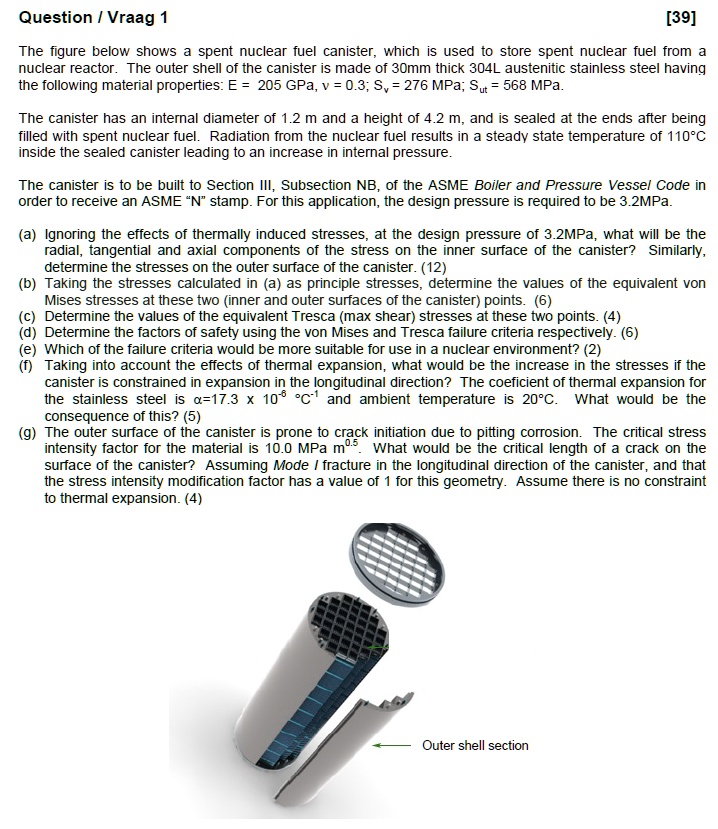
The figure below shows a spent nuclear fuel canister, which is used to store spent nuclear fuel from a
nuclear reactor. The outer shell of the canister is made of 30mm thick 304L austenitic stainless steel having
the following material properties: E=205GPa,v=0.3;S_(v)=276MPa;S_(ut)=568MPa.
The canister has an internal diameter of 1.2m and a height of 4.2m, and is sealed at the ends after being
filled with spent nuclear fuel. Radiation from the nuclear fuel results in a steady state temperature of 110deg C
inside the sealed canister leading to an increase in internal pressure.
The canister is to be built to Section III, Subsection NB, of the ASME Boiler and Pressure Vessel Code in
order to receive an ASME " N " stamp. For this application, the design pressure is required to be 3.2MPa.
(a) Ignoring the effects of thermally induced stresses, at the design pressure of 3.2MPa, what will be the
radial, tangential and axial components of the stress on the inner surface of the canister? Similarly,
determine the stresses on the outer surface of the canister. (12)
(b) Taking the stresses calculated in (a) as principle stresses, determine the values of the equivalent von
Mises stresses at these two (inner and outer surfaces of the canister) points. (6)
(c) Determine the values of the equivalent Tresca (max shear) stresses at these two points. (4)
(d) Determine the factors of safety using the von Mises and Tresca failure criteria respectively. (6)
(e) Which of the failure criteria would be more suitable for use in a nuclear environment? (2)
(f) Taking into account the effects of thermal expansion, what would be the increase in the stresses if the
canister is constrained in expansion in the longitudinal direction? The coeficient of thermal expansion for
the stainless steel is alpha =17.3 imes 10^(-6)deg C^(-1) and ambient temperature is 20deg C. What would be the
consequence of this? (5)
(g) The outer surface of the canister is prone to crack initiation due to pitting corrosion. The critical stress
intensity factor for the material is 10.0MPam. What would be the critical length of a crack on the
surface of the canister? Assuming Mode I fracture in the longitudinal direction of the canister, and that
the stress intensity modification factor has a value of 1 for this geometry. Assume there is no constraint
to thermal expansion. (4)
Question/Vraag1
[39]
The figure below shows a spent nuclear fuel canister, which is used to store spent nuclear fuel from a nuclear reactor. The outer shell of the canister is made of 30mm thick 304L austenitic stainless steel having the following material properties:E=205 GPa,v =0.3;S,=276 MPaS=568 MPa
The canister has an internal diameter of 1.2 m and a height of 4.2 m, and is sealed at the ends after being filled with spent nuclear fuel. Radiation from the nuclear fuel results in a steady state temperature of 11oc inside the sealed canister leading to an increase in internal pressure.
The canister is to be built to Section III. Subsection NB. of the ASME Boiler and Pressure Vessel Code in
(a) Ignoring the effects of thermally induced stresses, at the design pressure of 3.2MPa, what will be the radial, tangential and axial components of the stress on the inner surface of the canister? Similarly, determine the stresses on the outer surface of the canister.(12) (b) Taking the stresses calculated in (a) as principle stresses, determine the values of the equivalent von Mises stresses at these two inner and outer surfaces of the canister points.6) (c) Determine the values of the equivalent Tresca (max shear) stresses at these two points. (4) (d) Determine the factors of safety using the von Mises and Tresca failure criteria respectively. (6) (e) Which of the failure criteria would be more suitable for use in a nuclear environment? (2) (f) Taking into account the effects of thermal expansion, what would be the increase in the stresses if the
the stainless steel is =17.3 x 10 c and ambient temperature is 20C.What would be the consequence of this?(5) (g) The outer surface of the canister is prone to crack initiation due to pitting corrosion. The critical stress intensity factor for the material is 10.0 MPa m What would be the critical length of a crack on the surface of the canister? Assuming Mode I fracture in the longitudinal direction of the canister, and that the stress intensity modification factor has a value of 1 for this geometry. Assume there is no constraint to thermal expansion.(4)
Outer shell section