Ace - AI Tutor
Ask Our Educators
Textbooks
My Library
Flashcards
Scribe - AI Notes
Notes & Exams
Download App
amy short

amy s.

Divider

Questions asked

BEST MATCH

3) The Sisyphean Corporation is considering investing in a new cane manufacturing machine that has an estimated life of three years. The cost of the machine is \$30,000 and the machine will be depreciated straight line over its three-year life to a residual value of \$0. The cane manufacturing machine will result in sales of 2000 canes in year 1. Sales are estimated to grow by 10% per year each year through year three. The price per cane that Sisyphean will charge its customers is \$18 each and is to remain constant. The canes have a manufacturing cost of \$9 each. Installation of the machine and the resulting increase in manufacturing capacity will require an increase in various net working capital accounts. It is estimated that the Sisyphean Corporation needs to hold 2% of its annual sales in cash, 4% of its annual sales in accounts receivable, 9% of its annual sales in inventory, and 6% of its annual sales in accounts payable. The firm is in the 21% tax bracket, and has a cost of capital of 10%. a. What is the incremental EBIT and the unlevered net income in the first year for the Sisyphean Corporation's project ? (5 points) b. What is the depreciation tax shield for the Sisyphean Corporation's project in the first year? (5 points)

View Answer
divider
BEST MATCH

Table 1 - Measurement Data) t 2.8 3.8 4.8 5.9 y 1.9 12.3 12.9 17.3 a) (The functional relationship f(t) is to be derived from the measurement data in table 1 by constructing an interpolation polynomial in Newton form.) i) (Use the measurement data from table 1 to complete the divided differences scheme in table 2.) t_i k=0 k=1 k=2 k=3 2.8 1.9 10.4 -4.9 3.8 12.3 0.6 2.1029 4.8 12.9 1.619 5.9 17.3 ii) Geben Sie das Interpolationspolynom in Newton-Form an. (Give the interpolation polynomial in Newton form) f(t) = 17.3 + 4.0 路 (t - 2.8) + 1.619 路 (t - 2.8) 路 (t - 3.8) + 2.1029 路 (t - 2.8) 路 (t - 3.8) 路 (t - 4.8) f(t) = 1.9 + 10.4 路 (t - 3.8) - 4.9 路 (t - 3.8) 路 (t - 4.8) + 2.1029 路 (t - 3.8) 路 (t - 4.8) 路 (t - 5.9) f(t) = 1.9 + 10.4 路 (t - 2.8) - 4.9 路 (t - 2.8) 路 (t - 3.8) + 2.1029 路 (t - 2.8) 路 (t - 3.8) 路 (t - 4.8) f(t) = 10.4 - 4.9 路 (t - 2.8) + 2.1029 路 (t - 2.8) 路 (t - 3.8) + 1.9 路 (t - 2.8) 路 (t - 3.8) 路 (t - 4.8) f(t) = 1.9 + 1 iii) Berechnen Sie mithilfe Ihres Interpolationspolynoms den Funktionswert an der Stelle t = 4.99. (Calculate the function value t = 4.99 using your interpolation polynomial) f(t = 4.99) = 12.9474 b) (From the measurement data in table 1, another functional relationship is to be provided by constructing a natural spline interpolation.) i) (Give the equation system with which the moments M_i = 0,1,2,3 are calculated.) M_0 M_1 M_2 M_3

View Answer
divider
BEST MATCH

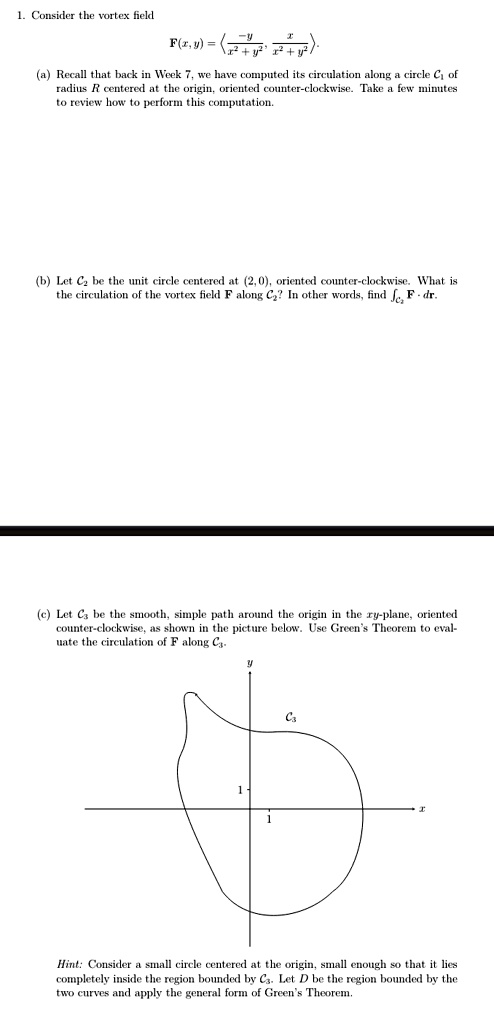
1. Consider the vortex field $F(x, y) = \left(\frac{-y}{x^2 + y^2}, \frac{x}{x^2 + y^2}\right)$. (a) Recall that back in Week 7, we have computed its circulation along a circle $C_1$ of radius $R$ centered at the origin, oriented counter-clockwise. Take a few minutes to review how to perform this computation. (b) Let $C_2$ be the unit circle centered at $(2, 0)$, oriented counter-clockwise. What is the circulation of the vortex field $F$ along $C_2$? In other words, find $\int_{C_2} F \cdot dr$. (c) Let $C_3$ be the smooth, simple path around the origin in the $xy$-plane, oriented counter-clockwise, as shown in the picture below. Use Green's Theorem to eval- uate the circulation of $F$ along $C_3$. Hint: Consider a small circle centered at the origin, small enough so that it lies completely inside the region bounded by $C_3$. Let $D$ be the region bounded by the two curves and apply the general form of Green's Theorem.
View Answer
divider
BEST MATCH

On a sunny day, a 50 ft flagpole casts a shadow that changes with the angle of elevation 胃. What is the rate at which the length of the shadow is changing with respect to 胃 when 胃 = 45掳?

View Answer
divider
BEST MATCH

Text: Find the value(s) of k that will cause the equation to have the given number and type of solutions. 8x^2 + kx + 8 = 0, 1 real solution

View Answer
divider
BEST MATCH

Compute the (i) net present value and (ii) internal rate of return of the following capital budgeting projects. The firm's required rate of return is 12 percent. Projects Year Zeta Omega 0 $(50,000) $(45,000) 1 $20,000 $42,000 2 $15,000 $9,000 3 $30,000 $1,850

View Answer
divider
BEST MATCH

6. Show the inverse kinematics calculations and determine the joint angles for the following robot if L1 = 1 m; L2 = 1.5 m, L3 = 3 m and L4 = 2.5 m. assume $\theta$ = 150掳 and X = 4 m and Y = 3 m.

View Answer
divider
BEST MATCH

Find the derivative. \(y = \frac{\cos x}{x^2}\)

View Answer
divider
BEST MATCH

1. In the figure below are three charges. Charge 1 is +5.00 碌C, charge 2 is -5.00 碌C and charge 3 is +5.00 碌C. The position of each charge is shown in the figure below. a) Find the x-component of the E-field at the position of q1 due to the other charges. (10 points) b) Find the y-component of the E-field at the position of q1 due to the other charges. (5 points) c) Find the force on q1 from the other charges and write your answer in vector notation. (10 points)

View Answer
divider
BEST MATCH

Vo = vo0 is tangential and ro = ror is radial. b) Find the total energy of the particle. (Write it in terms of m, and ro.) (c) Write down the F = ma equations for the system in polar coordinates. (See the note on the first page.) (d) The magnitude of the angular momentum is L = mr^2. (L points in the direction perpendicular to the plane of motion.) Using part c), show that L is conserved. (e) Suppose that 脦赂 is a constant (脦赂 < 0, where 脦赂 is some constant), and that the initial angular speed is 脧鈥皁. (Since vo and ro are perpendicular, 脧鈥皁 is just 脦赂.) Then use (c) to find the angular speed 脧鈥皌 and angle 脦赂t as functions of time. The answers will depend on 脦赂, 脧鈥皁, and ro. Assume the initial angle is 脦赂o = 0. Hint: if you don't know how to solve the resulting differential equation, look back to how we treated velocity-dependent force problems in chapter 2.)

View Answer
divider