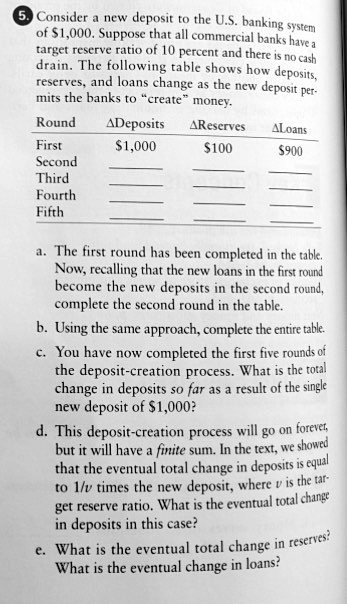
5. Consider a new deposit to the U.S. banking system
of $1,000. Suppose that all commercial banks have a
target reserve ratio of 10 percent and there is no cash
drain. The following table shows how deposits,
reserves, and loans change as the new deposit per-
mits the banks to \"create\" money.
Round
\DeltaDeposits
\DeltaReserves
\DeltaLoans
First
$1,000
$100
$900
Second
Third
Fourth
Fifth
a. The first round has been completed in the table.
Now, recalling that the new loans in the first round
become the new deposits in the second round,
complete the second round in the table.
b. Using the same approach, complete the entire table.
c. You have now completed the first five rounds of
the deposit-creation process. What is the total
change in deposits so far as a result of the single
new deposit of $1,000?
d. This deposit-creation process will go on forever,
but it will have a finite sum. In the text, we showed
that the eventual total change in deposits is equal
to $1/v$ times the new deposit, where $v$ is the tar-
get reserve ratio. What is the eventual total change
in deposits in this case?
e. What is the eventual total change in reserves?
What is the eventual change in loans?