a
tatus
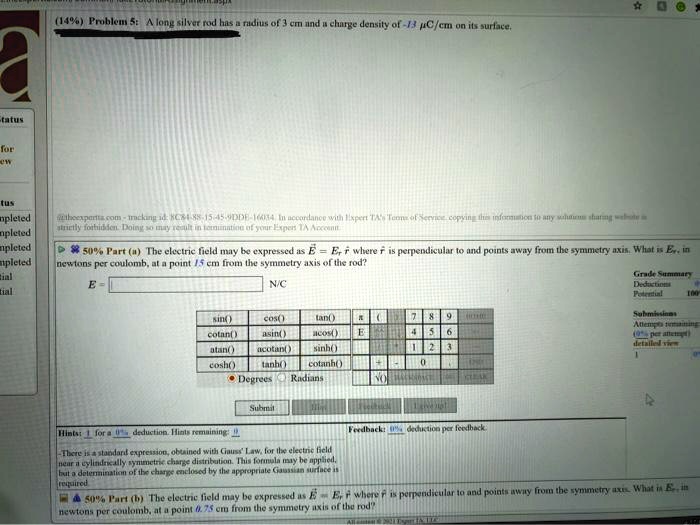
(14%) Problem 5: A long silver rod has a radius of 3 cm and a charge density of -13 µC/cm on its surface.
for
ew
tus
mpleted
mpleted
mpleted
mpleted
tial
theexpertta.com - tracking id: 8C84-88-15-45-9DDE-16034. In accordance with Expert TA's Terms of Service, copying this information to any solutions sharing website is
strictly forbidden. Doing so may result in termination of your Expert TA Account.
50% Part (a) The electric field may be expressed as $\vec{E} = E_r \hat{r}$, where $\hat{r}$ is perpendicular to and points away from the symmetry axis. What is $E_r$, in
newtons per coulomb, at a point 15 cm from the symmetry axis of the rod?
$E =$
N/C
sin()
cos()
tan()
7 8 9
cotan()
asin()
acos()
4 5 6
atan()
acot()
sinh()
1 2 3
cosh()
tanh()
cotanh()
0
Degrees
Radians
Submit
Grade Summary
Deductions
Potential
Submissions
Attempts remaining
(0% per attempt)
detailed view
Hints: 1 for a 0% deduction. Hints remaining: 1
There is a standard expression, obtained with Gauss' Law, for the electric field
near a cylindrically symmetric charge distribution. This formula may be applied,
but a determination of the charge enclosed by the appropriate Gaussian surface is
required.
Feedback: 0% deduction per feedback
50% Part (b) The electric field may be expressed as $\vec{E} = E_r \hat{r}$, where $\hat{r}$ is perpendicular to and points away from the symmetry axis. What is $E_r$ in
newtons per coulomb, at a point 8.75 cm from the symmetry axis of the rod?