Steganography deals with not only hiding messages, but also concealing the presence of
a hidden message. More modern steganographic methods typically encrypt messages
within digital media (images, audio files, video files, etc.), but they can also hide messages
in text. One method of concealing the message is to make the text appear as gibberish
or as though another cryptographic method is being used.
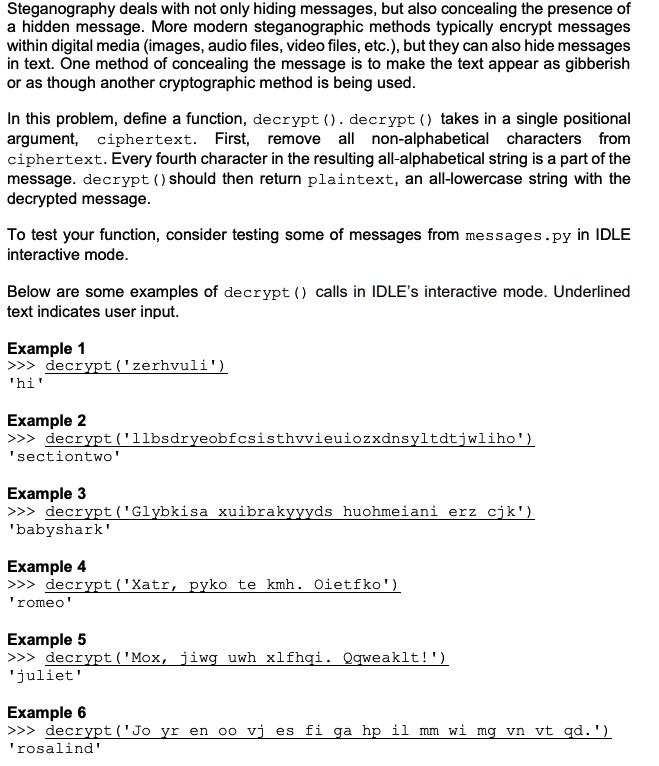
In this problem, define a function, decrypt (). decrypt() takes in a single positional
argument, ciphertext. First, remove all non-alphabetical characters from
ciphertext. Every fourth character in the resulting all-alphabetical string is a part of the
message. decrypt() should then return plaintext, an all-lowercase string with the
decrypted message.
To test your function, consider testing some of messages from messages.py in IDLE
interactive mode.
Below are some examples of decrypt() calls in IDLE's interactive mode. Underlined
text indicates user input.
Example 1
>>> decrypt('zerhvuli')
'hi'
Example 2
>>> decrypt('llbsdryeobfcsisthvvieuiozxdnsyltdtjwliho')
'sectiontwo'
Example 3
>>> decrypt('Glybkisa xuibrakyyyds huohmeiani erz cjk')
'babyshark'
Example 4
>>> decrypt ('Xatr, pyko te kmh. Oietfko')
'romeo'
Example 5
>>> decrypt('Mox, jiwg uwh xlfhqi. Qqweaklt!')
'juliet'
Example 6
>>> decrypt('Jo yr en oo vj es fi ga hp il mm wi mg vn vt qd.')
'rosalind'