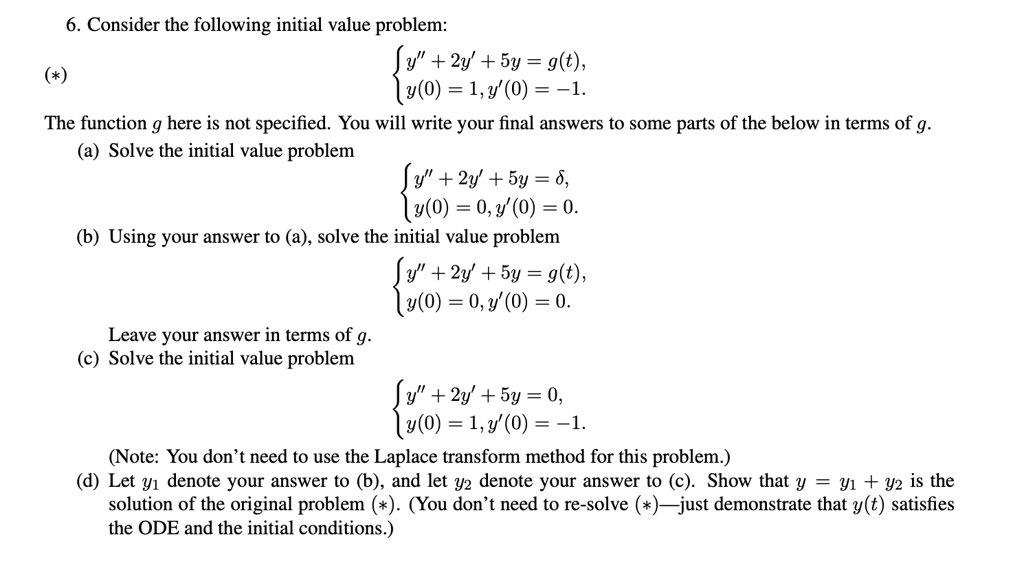
6. Consider the following initial value problem:
(*)
$\begin{cases} y'' + 2y' + 5y = g(t), \\ y(0) = 1, y'(0) = -1. \end{cases}$
The function $g$ here is not specified. You will write your final answers to some parts of the below in terms of $g$.
(a) Solve the initial value problem
$\begin{cases} y'' + 2y' + 5y = \delta, \\ y(0) = 0, y'(0) = 0. \end{cases}$
(b) Using your answer to (a), solve the initial value problem
$\begin{cases} y'' + 2y' + 5y = g(t), \\ y(0) = 0, y'(0) = 0. \end{cases}$
Leave your answer in terms of $g$.
(c) Solve the initial value problem
$\begin{cases} y'' + 2y' + 5y = 0, \\ y(0) = 1, y'(0) = -1. \end{cases}$
(Note: You don't need to use the Laplace transform method for this problem.)
(d) Let $y_1$ denote your answer to (b), and let $y_2$ denote your answer to (c). Show that $y = y_1 + y_2$ is the
solution of the original problem (*). (You don't need to re-solve (*)-just demonstrate that $y(t)$ satisfies
the ODE and the initial conditions.)