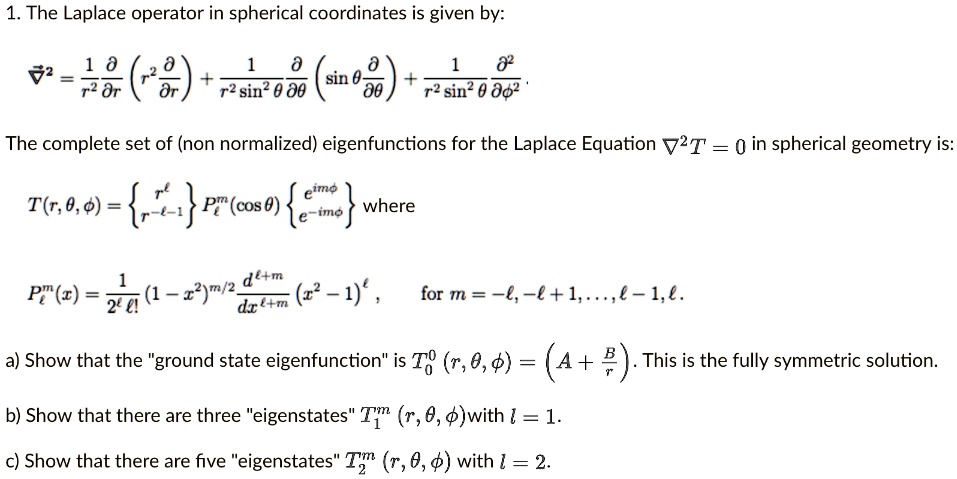
1. The Laplace operator in spherical coordinates is given by:
$\nabla^2 = \frac{1}{r^2} \frac{\partial}{\partial r} \left( r^2 \frac{\partial}{\partial r} \right) + \frac{1}{r^2 \sin^2 \theta} \frac{\partial}{\partial \theta} \left( \sin \theta \frac{\partial}{\partial \theta} \right) + \frac{1}{r^2 \sin^2 \theta} \frac{\partial^2}{\partial \phi^2}$.
The complete set of (non normalized) eigenfunctions for the Laplace Equation $\nabla^2 T = 0$ in spherical geometry is:
$T(r, \theta, \phi) = \left\{ r^l r^{-l-1} \right\} \left\{ P_l^m(\cos \theta) \right\} \left\{ e^{im\phi} e^{-im\phi} \right\}$ where
$P_l^m(x) = \frac{1}{2^l l!} (1 - x^2)^{m/2} \frac{d^{l+m}}{dx^{l+m}} (x^2 - 1)$, for $m = -l, -l + 1, ..., l - 1, l$.
a) Show that the \"ground state eigenfunction\" is $T_0^0 (r, \theta, \phi) = \left( A + \frac{B}{r} \right)$. This is the fully symmetric solution.
b) Show that there are three \"eigenstates\" $T_1^m (r, \theta, \phi)$ with $l = 1$.
c) Show that there are five \"eigenstates\" $T_2^m (r, \theta, \phi)$ with $l = 2$.