Ace - AI Tutor
Ask Our Educators
Textbooks
My Library
Flashcards
Scribe - AI Notes
Notes & Exams
Download App
andre thomas

andre t.

Divider

Questions asked

BEST MATCH

A situation in which there are negative consequences no matter which option you choose. This dilemma contributes to burnout, especially among nurses and allied health professionals

View Answer
divider
BEST MATCH

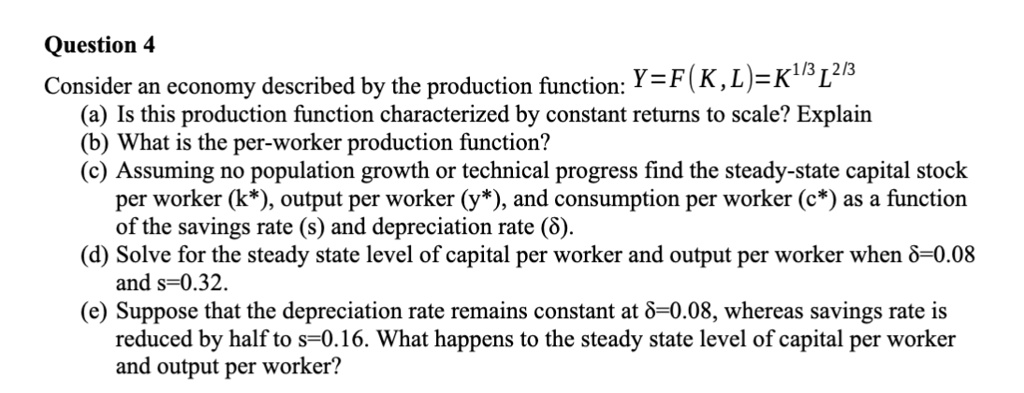
Question 4 Consider an economy described by the production function: $Y=F(K,L)=K^{1/3}L^{2/3}$ (a) Is this production function characterized by constant returns to scale? Explain (b) What is the per-worker production function? (c) Assuming no population growth or technical progress find the steady-state capital stock per worker ($k^*$), output per worker ($y^*$), and consumption per worker ($c^*$) as a function of the savings rate (s) and depreciation rate ($\delta$). (d) Solve for the steady state level of capital per worker and output per worker when $\delta=0.08$ and s=0.32. (e) Suppose that the depreciation rate remains constant at $\delta=0.08$, whereas savings rate is reduced by half to s=0.16. What happens to the steady state level of capital per worker and output per worker?
View Answer
divider
BEST MATCH

The potential energy of a particle undergoing 1D motion along the y-axis is U(y) = 5cy2, where c = 2 N/m. Its total energy at y = 0 is 12 J, and it is only subject to conservative forces. Find a) the positions where its kinetic energy is zero. b) the forces at those positions.

View Answer
divider
BEST MATCH

1. Is a one proportion confidence interval helpful for understanding how a population relatesto a question of interest? 2. Prepare: • Break down the question so that you are only addressing the statistical analysis • Identify $\hat{p}$ and n (the proportion and the number of observations in the sample); the sample proportion is the point estimate • Decide how confident you want to be (i.e., your \"confidence level\": most typically, 95%, 99%) Confidence Level Z 80% 1.282 85% 1.440 90% 1.645 95% 1.960 99% 2.576 99.5% 2.807 99.9% 3.291 • Identify the z* score associated with your confidence level using the chart to the right 3. Check conditions and assumptions: • Make sure $\hat{p}$ is nearly normal based on whether the sample is random • Check the success-failure condition to see if the sample is large enough (use $\hat{p}$since we don't know p; np and n(1-p) must both be greater than 10) 4. Calculate the following (if the conditions hold): • Compute the standard error (SE) (you are using $\hat{p}$ in place of p): $SE(\hat{p}) = \sqrt{\frac{\hat{p}(1-\hat{p})}{n}}$ • Construct the margin of error using the formula SE(z*) • State the confidence interval: Point estimate $\pm$ the margin of error

View Answer
divider
BEST MATCH

Which number equals $2^{-3}$?

View Answer
divider
BEST MATCH

What term describes a layered security approach that provides the comprehensive protection

View Answer
divider
BEST MATCH

2. Sales tax policies can vary dramatically across jurisdictions, leading to disparities in revenue collection and economic growth. Consider the differing approaches between states, regions, and even countries. a. How might these variations impact businesses operating in different areas? b. How do policymakers balance revenue generation with fostering economic activity?

View Answer
divider
BEST MATCH

If X and Y are discrete random variables, each taking only THREE distinct values, prove that X and Y are independent if and only if E(XY ) = E(X)E(Y). It is necessary that the proof is with only three different values

View Answer
divider
BEST MATCH

A spin-1/2 particle is in a normalized quantum state $|\psi\rangle$ that is a superposition of the $\hat{S}_z$ eigenstates, $|\psi\rangle = a|\uparrow\rangle + b|\downarrow\rangle$, (1) where $a$ and $b$ are complex constants in general. The associated expectation values of $\hat{S}_z$ and $\hat{S}_y$ are 0 and $\frac{\hbar}{2}$ respectively. Determine the constants $a$ and $b$. You can set the overall phase such that $a$ is real and $b$ is complex.

View Answer
divider
BEST MATCH

A tank of Dry Air at room temperature is steadily vented through a converging-diverging nozzle to atmospheric pressure. We desire a flow rate of 0.1 kg/s of gas at Mach 1 exiting the nozzle. Please answer the following questions: A. Find the pressure required in the tank to achieve this flow speed. B. Find the velocity of the gas at the exit. C. What is the exit area of the nozzle? D. Find the area of the throat required to permit the correct flow rate.

View Answer
divider