Ace - AI Tutor
Ask Our Educators
Textbooks
My Library
Flashcards
Scribe - AI Notes
Notes & Exams
Download App
andrea farmer

andrea f.

Divider

Questions asked

BEST MATCH

Tendons and ligaments are composed primarily of what type of tissue? Multiple Choice Reticular connective tissue Dense irregular tissue Muscle tissue Dense regular connective tissue

View Answer
divider
BEST MATCH

Problem 1 (25 points) A gas stream contains (H2S and CO2) with (CO2=0.75) mole fraction flows at a rate of 30 mole/min. It is mixed with a stream of air to reduce H2S mole fraction to (0.05). What should be the flow rate of air in liter/hr? Calculate mole fraction of air in the mixed stream.

View Answer
divider
BEST MATCH

A rerun of an old TV episode had an audience of 15% instead of the usual 13% was a percentage increase

View Answer
divider
BEST MATCH

The reaction represented above goes essentially to completion. The reaction takes place in a rigid, insulated vessel that is initially at 600 K. What can be inferred about S° for the reaction at 600 K? (A) It must be positive, since the reaction is thermodynamically unfavorable at 600 K. (B) It must be negative, since there are more moles of products than reactants. (C) It must be positive, since G° is negative and H° is positive. (D) It must be negative, since G° is positive and H° is positive.

View Answer
divider
BEST MATCH

Exhibit 9-3 n = 49 \bar{x} = 54.8 s = 28 H_0: \mu \leq 50 H_a: \mu > 50 10. Refer to Exhibit 9-3. The test statistic is a. 0.1714 b. 0.3849 c. -1.2 d. 1.2 11. Refer to Exhibit 9-3. The $p$-value is between a. 0.01 to 0.025 b. 0.025 to 0.05 c. .05 to 0.1 d. 0.1 to 0.2 12. Refer to Exhibit 9-3. If the test is done at the 5\% level of significance, the null hypothesis should a. not be rejected b. be rejected c. Not enough information given to answer this question. d. None of these alternatives is correct.

View Answer
divider
BEST MATCH

65% of 114 dufa in the el. Do the data prove appropriate hypothesis test that the p = 0.

View Answer
divider
BEST MATCH

For the socket wrench extension shown in the figure, compute the maximum torsional shear stress in the middle portion where the diameter is 12 mm. The applied torque is 16.0 N.m.

View Answer
divider
BEST MATCH

1. Convert the logic circuit in Figure 1 to logic circuit using 2-input NAND universal gates only. [2.5 marks] 2. Convert the logic circuit in Figure 2 to logic circuit using basic gates (AND, OR, NOT) only. [5 marks]

View Answer
divider
BEST MATCH

1. Sketch a 2-input NOR gate with transistor widths chosen to achieve effective rise and fall resistances equal to the inverter below (the widths of the inverter are shown in the figure). Assume the length of each transistor is set as 1. A 2 A 1 a= B Y ; b= [c] [d] [a] [b] Y ; c= ; d= 2. assume the nmos of the Inverter has resistance R and capacitance C, and the two PMOS of the NOR circuits share a common source/drain Compute the rising and falling propagation delays of the NOR gate driving h identical NOR gates using the Elmore delay model. Rising propagation delay is RC; falling propagation delay is RC. 3. assume the nmos of the Inverter has resistance R and capacitance C, and the two PMOS of the NOR circuits share a common source/drain Compute the rising and falling contamination delays of the NOR gate driving h identical NOR gates using the Elmore delay model. Rising contamination delay is RC; falling contamination delay is RC.

View Answer
divider
BEST MATCH

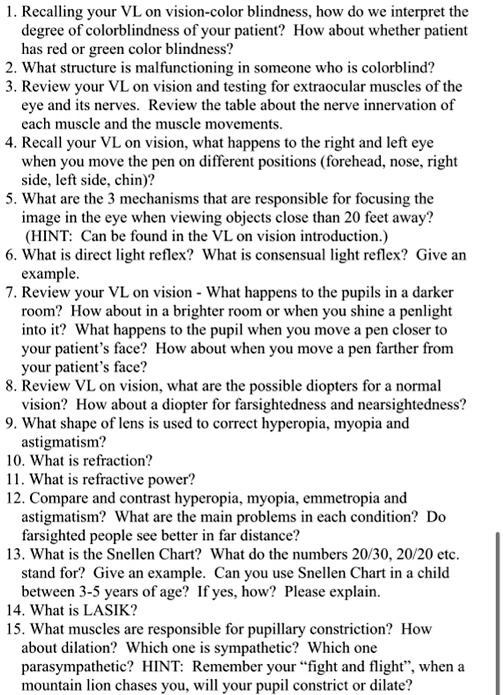
1. Recalling your VL on vision-color blindness, how do we interpret the degree of color blindness of your patient? How about whether the patient has red or green color blindness? 2. What structure is malfunctioning in someone who is colorblind? 3. Review your VL on vision and testing for extraocular muscles of the eye and its nerves. Review the table about the nerve innervation of each muscle and the muscle movements. 4. Recall your VL on vision, what happens to the right and left eye when you move the pen to different positions (forehead, nose, right side, left side, chin)? 5. What are the 3 mechanisms that are responsible for focusing the image in the eye when viewing objects closer than 20 feet away? (HINT: Can be found in the VL on vision introduction.) 6. What is the direct light reflex? What is the consensual light reflex? Give an example. 7. Review your VL on vision - What happens to the pupils in a darker room? How about in a brighter room or when you shine a penlight into it? What happens to the pupil when you move a pen closer to your patient's face? How about when you move a pen farther from your patient's face? 8. Review VL on vision, what are the possible diopters for normal vision? How about a diopter for farsightedness and nearsightedness? 9. What shape of lens is used to correct hyperopia, myopia, and astigmatism? 10. What is refraction? 11. What is refractive power? 12. Compare and contrast hyperopia, myopia, emmetropia, and astigmatism. What are the main problems in each condition? Do farsighted people see better in the far distance? 13. What is the Snellen Chart? What do the numbers 20/30, 20/20, etc., stand for? Give an example. Can you use the Snellen Chart in a child between 3-5 years of age? If yes, how? Please explain. 14. What is LASIK? 15. What muscles are responsible for pupillary constriction? How about dilation? Which one is sympathetic? Which one is parasympathetic? HINT: Remember your fight and flight, when a mountain lion chases you, will your pupil constrict or dilate?
View Answer
divider