Ace - AI Tutor
Ask Our Educators
Textbooks
My Library
Flashcards
Scribe - AI Notes
Notes & Exams
Download App
andrea guerrero

andrea g.

Divider

Questions asked

BEST MATCH

Question 2 1 pts Glucose absorption takes place in intestinal cells via __________, requiring energy.

View Answer
divider
BEST MATCH

a 0.2 kg rope is stretched a length of 1.6m. One end of the rope hangs over a strut attached to a mass if 14kg. The other end of the rope is attached to an oscillator which vibrates so that the rope is its fith harmonic. The top of the bubbles is 0.6m above the bottom of that bubble. Write out an explicit expression for the rope

View Answer
divider
BEST MATCH

. b-Oxidation of an odd chain fatty acid results in release of a three carbon acylCoA called ____________________________. In a three step process it is made into the citric acid cycle intermediate _______________________. This process requires carboxylation using the cofactor ____________________, and vitamin ________ for a rearrangement.

View Answer
divider
BEST MATCH

11 5 points How are cytotoxic T cells and natural killer cells similar? require antibody to be present do not bind to infected cells effective against virally infected cells recognize antigen in association with human leukocyte antigen class II markers

View Answer
divider
BEST MATCH

Identify the nonspecific word(s) in this statement: In this family, we are going to talk to each other more than we used to.

View Answer
divider
BEST MATCH

Given matrix $A = \begin{bmatrix} 1 \\ 1 \end{bmatrix} \begin{bmatrix} 2 \\ 3 \end{bmatrix}$ and the encrypted message matrix $M = \begin{bmatrix} 32 & 20 \\ 37 & 21 \end{bmatrix}$, find the secret message. Decoding Information - Use the following coding system to decode your final message: A=1 B=2 C=3 D=4 E=5 F=6 G=7 H=8 I=9 J=10 K=11 L=12 M=13 N=14 O=15 P=16 Q=17 R=18 S=19 T=20 U=21 V=22 W=23 X=24 Y=25 Z=26 and ANY SPACE will count as a "0".

View Answer
divider
BEST MATCH

Compare stabilizing, directional, and disruptive selection. Which is most consistent with species radiating in a given location?

View Answer
divider
BEST MATCH

1. (a) A 60 m × 50 m cargo handling area (Figure Q1.1) requires an average maintained illuminance of 50 lux. The floodlight with data given in Figure Q1.2 is selected for the illumination of this area. Six 15 m poles are built on both 60 m sides offset by 5 m from the edge of the area (Figure Q1.1). The peak intensity of the luminaires is aimed at a point 2/3 across the width of the area. Calculate the number of luminaires required on each lamp pole (all lamp poles have the same number of luminaires). Given the following data: Initial flux output of the 400W high pressure sodium lamp = 48,000 lm Lamp lumen maintenance factor LLMF = 0.85 Luminaire maintenance factor LMF = 0.8 Atmospheric loss factor = 1.0 Assume lamp is replaced immediately when it fails (b) With the number of luminaires calculated in (a), calculate: (i) the average maintained illuminance on the area (ii) the maintained illuminance at the centre of the area (iii) the maintained illuminance at the corners of the area

View Answer
divider
BEST MATCH

Link OA revolves counterclockwise with an angular velocity of 4.3 rad/s. Link AB slides through the pivoted collar at C. Determine the angular velocity $\omega$ (positive if counterclockwise, negative if clockwise) of AB when $\theta = 32^\circ$

View Answer
divider
BEST MATCH

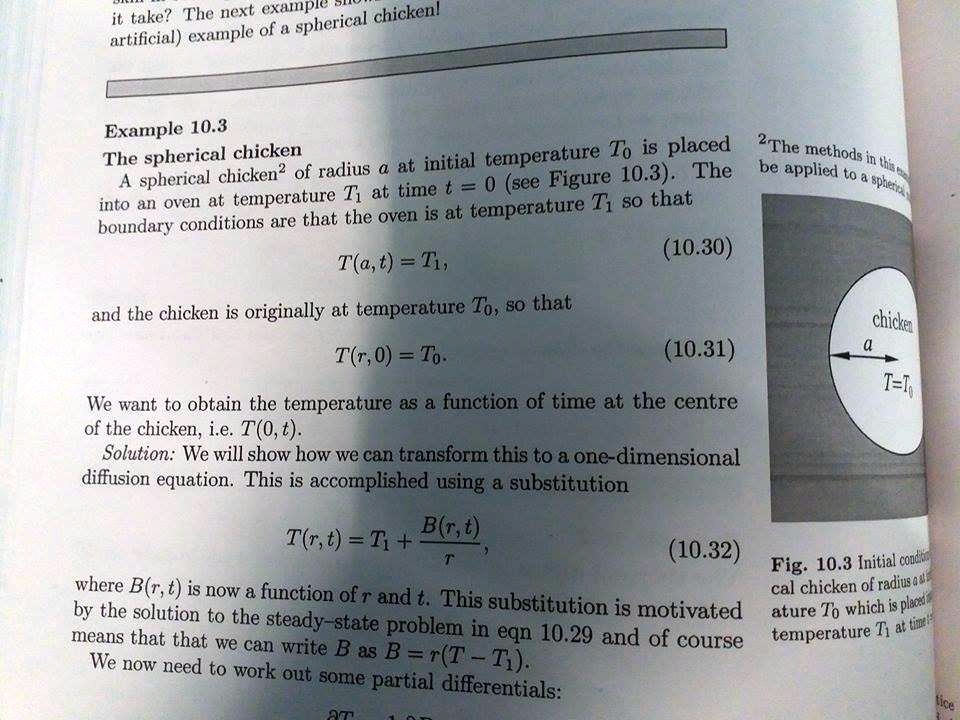
it take? The next example artificial) example of a spherical chicken! Example 10.3 The spherical chicken A spherical chicken of radius $a$ at initial temperature $T_0$ is placed into an oven at temperature $T_1$ at time $t = 0$ (see Figure 10.3). The boundary conditions are that the oven is at temperature $T_1$ so that $T(a, t) = T_1$, (10.30) and the chicken is originally at temperature $T_0$, so that $T(r, 0) = T_0$. (10.31) We want to obtain the temperature as a function of time at the centre of the chicken, i.e. $T(0, t)$. Solution: We will show how we can transform this to a one-dimensional diffusion equation. This is accomplished using a substitution $T(r, t) = T_1 + \frac{B(r, t)}{r}$, (10.32) where $B(r, t)$ is now a function of $r$ and $t$. This substitution is motivated by the solution to the steady-state problem in eqn 10.29 and of course means that that we can write $B$ as $B = r(T - T_1)$. We now need to work out some partial differentials: $\frac{\partial T}{\partial t}$
View Answer
divider