Need help with questions 6-10:
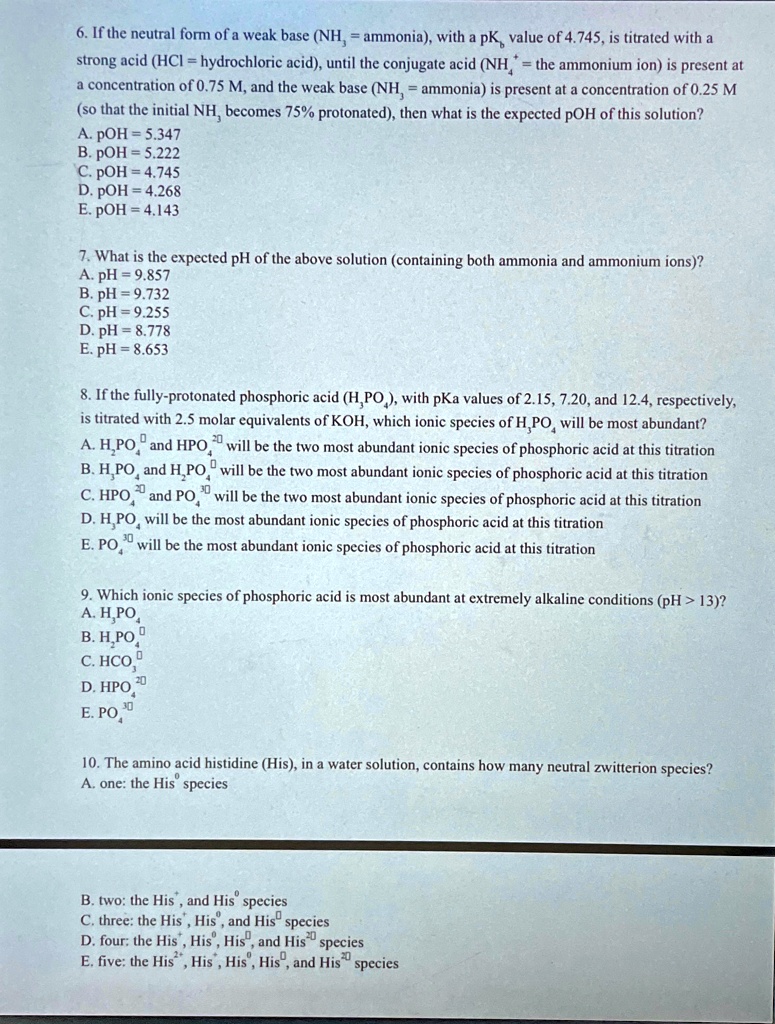
6. If the neutral form of a weak base (NH3 = ammonia, with a pKa value of 4.745, is titrated with a strong acid (HCl = hydrochloric acid), until the conjugate acid (NH4+ = the ammonium ion) is present at a concentration of 0.75 M, and the weak base (NH3 = ammonia) is present at a concentration of 0.25 M so that the initial NH3 becomes 75% protonated), then what is the expected pOH of this solution? A. pOH = 5.347 B. pOH = 5.222 C. pOH = 4.745 D. pOH = 4.268 E. pOH = 4.143
7. What is the expected pH of the above solution (containing both ammonia and ammonium ions)? A. pH = 9.857 B. pH = 9.732 C. pH = 9.255 D. pH = 8.778 E. pH = 8.653
8. If the fully-protonated phosphoric acid (H3PO4 with pKa values of 2.15, 7.20, and 12.4, respectively) is titrated with 2.5 molar equivalents of KOH, which ionic species of H3PO4 will be most abundant? A. H2PO4- and HPO4^2- will be the two most abundant ionic species of phosphoric acid at this titration B. H2PO4- and H3PO4 will be the two most abundant ionic species of phosphoric acid at this titration C. HPO4^2- and PO4^3- will be the two most abundant ionic species of phosphoric acid at this titration D. H3PO4 will be the most abundant ionic species of phosphoric acid at this titration E. PO4^3- will be the most abundant ionic species of phosphoric acid at this titration
9. Which ionic species of phosphoric acid is most abundant at extremely alkaline conditions (pH > 13)? A. H2PO4- B. HPO4^2- C. HPO4^3- D. H3PO4 E. PO4^3-
10. The amino acid histidine (His) in a water solution contains how many neutral zwitterion species? A. one: the His species B. two: the His and His+ species C. three: the His, His+, and His- species D. four: the His, His+, His-, and His2+ species E. five: the His, His+, His-, His2+, and His2- species