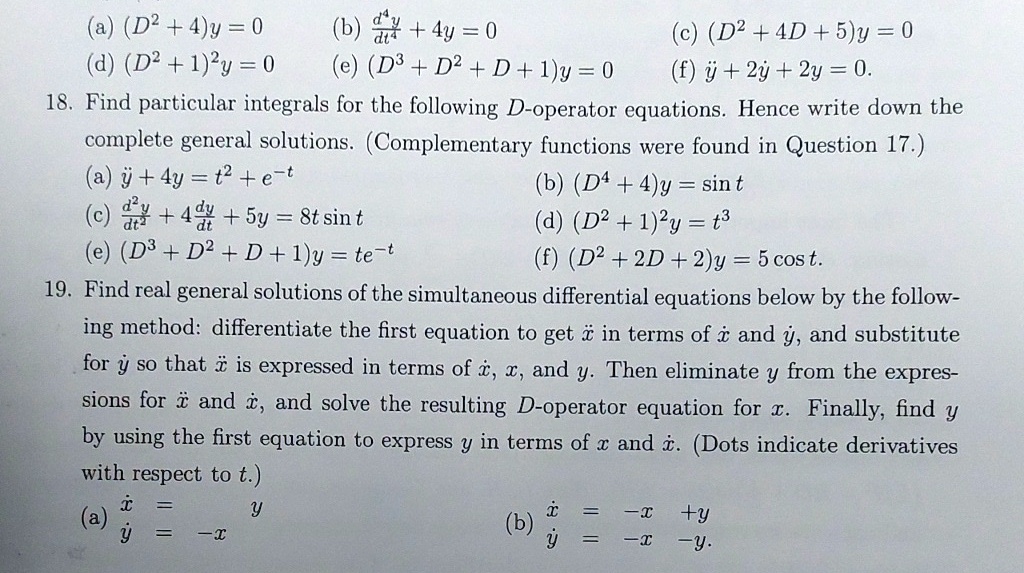
(a) $(D^2 + 4)y = 0$
(b) $\frac{d^4y}{dt^4} + 4y = 0$
(c) $(D^2 + 4D + 5)y = 0$
(d) $(D^2 + 1)^2y = 0$
(e) $(D^3 + D^2 + D + 1)y = 0$
(f) $\ddot{y} + 2\dot{y} + 2y = 0$.
18. Find particular integrals for the following D-operator equations. Hence write down the
complete general solutions. (Complementary functions were found in Question 17.)
(a) $\ddot{y} + 4y = t^2 + e^{-t}$
(c) $\frac{d^2y}{dt^2} + 4\frac{dy}{dt} + 5y = 8t \sin t$
(e) $(D^3 + D^2 + D + 1)y = te^{-t}$
(b) $(D^4 + 4)y = \sin t$
(d) $(D^2 + 1)^2y = t^3$
(f) $(D^2 + 2D + 2)y = 5 \cos t$.
19. Find real general solutions of the simultaneous differential equations below by the follow-
ing method: differentiate the first equation to get $\ddot{x}$ in terms of $\dot{x}$ and $\dot{y}$, and substitute
for $\dot{y}$ so that $\ddot{x}$ is expressed in terms of $\dot{x}$, $x$, and $y$. Then eliminate $y$ from the expres-
sions for $\ddot{x}$ and $\dot{x}$, and solve the resulting D-operator equation for $x$. Finally, find $y$
by using the first equation to express $y$ in terms of $x$ and $\dot{x}$. (Dots indicate derivatives
with respect to $t$.)
(a) $\dot{x} = y$
$\dot{y} = -x$
(b) $\dot{x} = -x + y$
$\dot{y} = -x - y.$