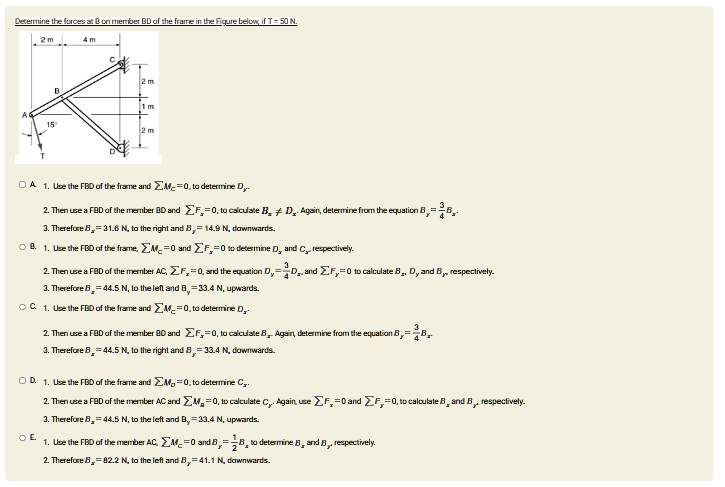
Determine the forces at B on member BD of the frame in the Figure below, if T = 50 N.
2 m
4 m
C
B
2 m
1 m
A
15°
2 m
D
T
A. 1. Use the FBD of the frame and $\sum M_C=0$, to determine $D_y$.
2. Then use a FBD of the member BD and $\sum F_x=0$, to calculate $B_x \neq D_x$. Again, determine from the equation $B_y = \frac{3}{4}B_x$.
3. Therefore $B_x=31.6$ N, to the right and $B_y=14.9$ N, downwards.
B. 1. Use the FBD of the frame, $\sum M_C=0$ and $\sum F_x=0$ to determine $D_x$ and $C_x$, respectively.
2. Then use a FBD of the member AC, $\sum F_x=0$, and the equation $D_y = \frac{3}{4}D_x$, and $\sum F_y=0$ to calculate $B_x$, $D_y$, and $B_y$, respectively.
3. Therefore $B_x=44.5$ N, to the left and $B_y=33.4$ N, upwards.
C. 1. Use the FBD of the frame and $\sum M_C=0$, to determine $D_x$.
2. Then use a FBD of the member BD and $\sum F_x=0$, to calculate $B_x$. Again, determine from the equation $B_y = \frac{3}{4}B_x$.
3. Therefore $B_x=44.5$ N, to the right and $B_y=33.4$ N, downwards.
D. 1. Use the FBD of the frame and $\sum M_D=0$, to determine $C_x$.
2. Then use a FBD of the member AC and $\sum M_B=0$, to calculate $C_y$. Again, use $\sum F_x=0$ and $\sum F_y=0$, to calculate $B_x$ and $B_y$, respectively.
3. Therefore $B_x=44.5$ N, to the left and $B_y=33.4$ N, upwards.
E. 1. Use the FBD of the member AC, $\sum M_C=0$ and $B_y = \frac{1}{2}B_x$ to determine $B_x$ and $B_y$, respectively.
2. Therefore $B_x=82.2$ N, to the left and $B_y=41.1$ N, downwards.