Homework Chapters 11 and 13
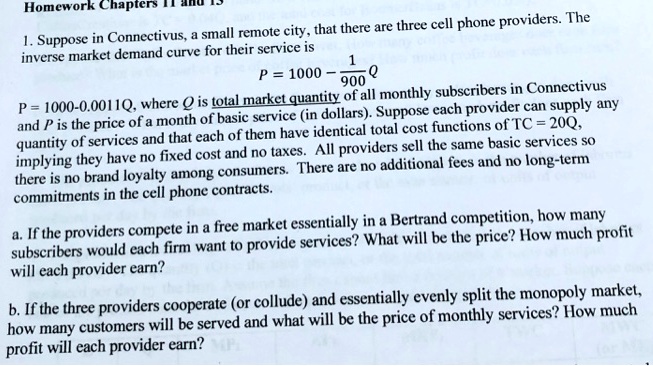
1. Suppose in Connectivus, a small remote city, that there are three cell phone providers. The
inverse market demand curve for their service is
$\qquad P = 1000 - \frac{1}{900}Q$
P = 1000-0.0011Q, where Q is total market quantity of all monthly subscribers in Connectivus
and P is the price of a month of basic service (in dollars). Suppose each provider can supply any
quantity of services and that each of them have identical total cost functions of TC = 20Q,
implying they have no fixed cost and no taxes. All providers sell the same basic services so
there is no brand loyalty among consumers. There are no additional fees and no long-term
commitments in the cell phone contracts.
a. If the providers compete in a free market essentially in a Bertrand competition, how many
subscribers would each firm want to provide services? What will be the price? How much profit
will each provider earn?
b. If the three providers cooperate (or collude) and essentially evenly split the monopoly market,
how many customers will be served and what will be the price of monthly services? How much
profit will each provider earn?