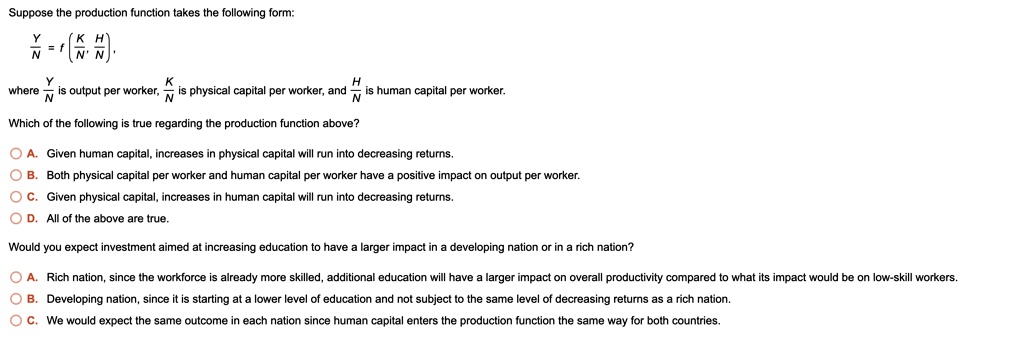
Suppose the production function takes the following form:
\frac{Y}{N} = f\left(\frac{K}{N}, \frac{H}{N}\right),
where $\frac{Y}{N}$ is output per worker, $\frac{K}{N}$ is physical capital per worker, and $\frac{H}{N}$ is human capital per worker.
Which of the following is true regarding the production function above?
A. Given human capital, increases in physical capital will run into decreasing returns.
B. Both physical capital per worker and human capital per worker have a positive impact on output per worker.
C. Given physical capital, increases in human capital will run into decreasing returns.
D. All of the above are true.
Would you expect investment aimed at increasing education to have a larger impact in a developing nation or in a rich nation?
A. Rich nation, since the workforce is already more skilled, additional education will have a larger impact on overall productivity compared to what its impact would be on low-skill workers.
B. Developing nation, since it is starting at a lower level of education and not subject to the same level of decreasing returns as a rich nation.
C. We would expect the same outcome in each nation since human capital enters the production function the same way for both countries.