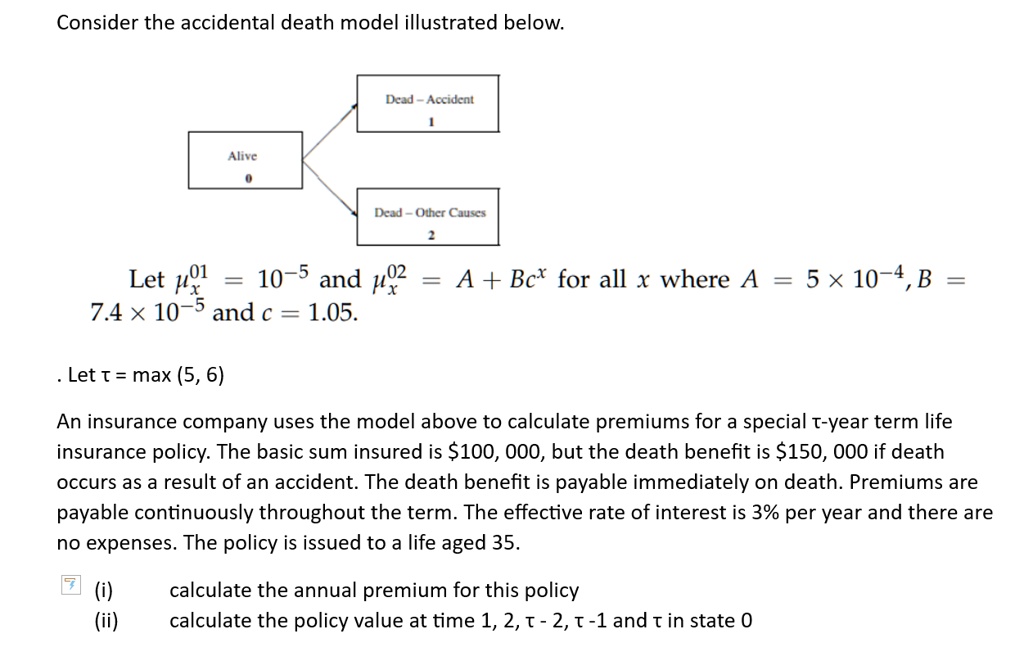
Consider the accidental death model illustrated below.
Alive
0
Dead-Accident
1
Dead-Other Causes
2
01
X
Let \(\mu_x^{01} = 10^{-5}\) and \(\mu_x^{02} = A + Bc^x\) for all x where \(A = 5 \times 10^{-4}\), \(B = 7.4 \times 10^{-5}\) and \(c = 1.05\).
. Let t = max (5, 6)
An insurance company uses the model above to calculate premiums for a special t-year term life insurance policy. The basic sum insured is $100, 000, but the death benefit is $150, 000 if death occurs as a result of an accident. The death benefit is payable immediately on death. Premiums are payable continuously throughout the term. The effective rate of interest is 3% per year and there are no expenses. The policy is issued to a life aged 35.
(i) calculate the annual premium for this policy
(ii) calculate the policy value at time 1, 2, \(\tau - 2\), \(\tau - 1\) and t in state 0