Questions asked
Originally, heat-shock proteins were identified as proteins produced in response to increased temperature; now it is known that some of these proteins act as O molecular chaperones that regulate protein folding. O protein-tyrosine kinases. O proteases that eliminate ubiquitin-tagged proteins. O transmembrane G proteins. O transcription activators.
What does antagonism in hormonal interactions refer to? One hormone inhibits the activity of another hormone. Hormones act independently without influencing each other. Hormones work together to enhance their effects. One hormone allows another hormone to exert its full effect.
Which programming language does BigQuery work with? SQL Python Java R
Required information The lever BCD is hinged at C and attached to a control rod at B as shown in the figure. Given: $P = 110 lb$. 7.5 in. P D A $90^\circ$ 3 in. C 4 in. B Determine the reaction at C. The reaction at C is $\boxed{}$ lb $\angle \boxed{}$ $^\circ$.
2. iliac Crest 2. iliac fossa 3. Anterior superior iliac Spine 4. Anterior inferior iliac spine 5. 6. 7. 8. 9. Inferior pubic ramus Pelvis and Thigh Hip p. 281 Please identify the following structures. 10. Posterior superior iliac spine 11. 12. 13. Ischial spine 14. 15. 16. Ischial tuberosity Medial view of right hip 17. CHOICES Acetabulum Anterior gluteal line Anterior inferior iliac spine (2) Anterior superior iliac spine (2) Greater sciatic notch (2) Iliac crest (2) Iliac fossa Iliac tubercle Inferior gluteal line Inferior ramus of pubis (2) Ischial spine (2) Ischial tuberosity (2) Lesser sciatic notch (2) Obturator foramen (2) Pectineal line Posterior gluteal line Posterior inferior iliac spine (2) Posterior superior iliac spine (2) Pubic tubercle (2) Ramus of the ischium Superior ramus of pubis (2) Symphyseal surface 18. 19. 20. 21. 22. 23. 24. 25. 26. 27. Guide to the Body Student Workbook 28. 29. Anterior surface 30. 31. 32. 33. 34. 35. Lateral view of right hip
Example of a latent viral infection: a. Hepatitis b. influenza c. polio d. cold sores
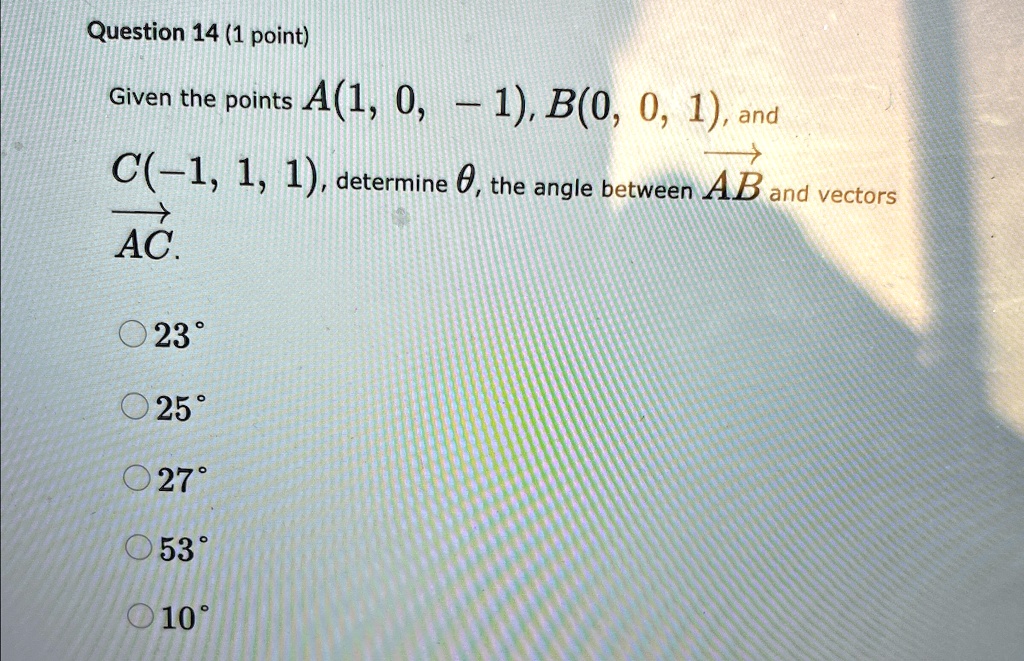
Question 14 (1 point) Given the points A(1, 0, \text{-}1), B(0, 0, 1), and C(-1, 1, 1), determine $\theta$, the angle between $\overrightarrow{AB}$ and vectors $\overrightarrow{AC}$. 23° 25° 27° 53° 10°
Compute for the value of R_(D) and R_(s) that will result in a voltage gain A_(v)=10 using a relatively high level of g_(m) for this device defined at V_(GS_(Q))=(1)/(4)V_(P) R_(D)= ◻ R_(s)= Compute for the value of R and R that will result in a voltage gain A = 10 using a relatively high = Von +20V WV C G 0.1F oV RI 10MI 0.1uF R6 10M Ips=10-mA Vp=-4V So=20S MM C 40uF R.
A natural monopoly is most likely to exist when: a. there are extremely large economies of scale. b. there are non-normal profits. c. there is government regulation of the industry. d. there are long-term patents in an industry. e. there are large barriers to entry. A monopoly is any market controlled by a single seller. A natural monopoly is a specific type of monopoly. It is a monopoly that has high start-up costs, economies of scale, or other naturally occurring barriers to entry. Question 13: A natural monopoly is most likely to exist when there are extremely large economies of scale, there are non-normal profits, there is government regulation of the industry, there are long-term patents in an industry, or there are large barriers to entry. A monopoly is any market controlled by a single seller with high start-up costs, economies of scale, or other naturally occurring barriers to entry.
Consider the following hypothesis test. $H_0: \mu_1 - \mu_2 \leq 0$ $H_a: \mu_1 - \mu_2 > 0$ The following results are for two independent samples taken from the two populations. \begin{tabular}{|l|l|} Sample 1 & Sample 2 \\ $n_1 = 40$ & $n_2 = 50$ \\ $\bar{x}_1 = 25.4$ & $\bar{x}_2 = 22.8$ \\ $\sigma_1 = 5.7$ & $\sigma_2 = 6$ \\ \end{tabular} (a) What is the value of the test statistic? (Round your answer to two decimal places.) (b) What is the $p$-value? (Round your answer to four decimal places.) (c) With $\alpha = 0.05$, what is your hypothesis testing conclusion? $\circ$ Do not reject $H_0$. There is insufficient evidence to conclude that $\mu_1 - \mu_2 > 0$. $\circ$ Do not Reject $H_0$. There is sufficient evidence to conclude that $\mu_1 - \mu_2 > 0$. $\circ$ Reject $H_0$. There is insufficient evidence to conclude that $\mu_1 - \mu_2 > 0$. $\circ$ Reject $H_0$. There is sufficient evidence to conclude that $\mu_1 - \mu_2 > 0$.