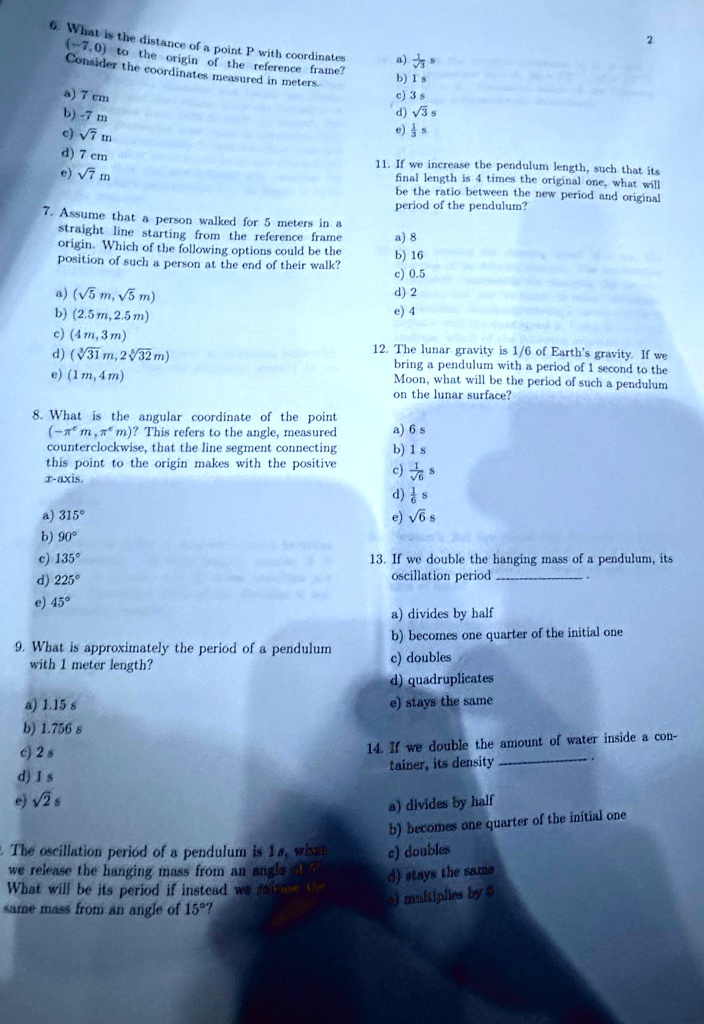
1. What is the distance of a point P with coordinates (-7,0) to the origin of the reference frame? Consider the coordinates measured in meters.
a) 7cm
b) -7m
c) sqrt{7}m
d) 7cm
e) sqrt{7}m
2. Assume that a person walked for 5 meters in a straight line starting from the reference frame origin. Which of the following options could be the position of such a person at the end of their walk?
a) (sqrt{5}m,sqrt{5}m)
b) (2.5m,2.5m)
c) (4m,3m)
d) (sqrt[3]{31}m,2sqrt[6]{32}m)
e) (1m,4m)
3. What is the angular coordinate of the point (-pi^{epsilon}m,pi^{epsilon}m)? This refers to the angle, measured counterclockwise, that the line segment connecting this point to the origin makes with the positive x-axis.
a) 315deg
b) 90deg
c) 135deg
d) 225deg
e) 45deg
4. What is approximately the period of a pendulum with 1 meter length?
a) 1.15s
b) 1.756s
c) 2s
d) 1s
e) sqrt{28}
5. The oscillation period of a pendulum is 18, when we release the hanging mass from an angle of 5deg. What will be its period if instead we release the same mass from an angle of 15deg?
a) frac{1}{sqrt{3}}s
b) 1s
c) 3s
d) sqrt{3}s
e) frac{1}{3}s
6. If we increase the pendulum length, such that its final length is 4 times the original one, what will be the ratio between the new period and original period of the pendulum?
a) 8
b) 16
c) 0.5
d) 2
e) 4
7. The lunar gravity is frac{1}{6} of Earth's gravity. If we bring a pendulum with a period of 1 second to the Moon, what will be the period of such a pendulum on the lunar surface?
a) 6s
b) 1s
c) frac{1}{sqrt{6}}s
d) frac{1}{6}s
e) sqrt{6}s
8. If we double the hanging mass of a pendulum, its oscillation period
a) divides by half
b) becomes one quarter of the initial one
c) doubles
d) quadruplicates
e) stays the same
9. If we double the amount of water inside a container, its density
a) divides by half
b) becomes one quarter of the initial one
c) doubles
d) stays the same
e) multiplies by 8